Artwork 2019-2026
Index
Award-winning contemporary artist Dr. Iva Troj creates fine art pieces which seamlessly merge Renaissance aesthetics and techniques with postmodern praxis. Her intensely detailed images achieve astonishing tricks of light and shade, as practiced by the great masters while incorporating dreamlike scenes which challenge cultural norms.
In “The Red Painting,” created for the “Vanguard” exhibition at Melbourne’s Outré Gallery, Iva Troj continues her masterful dialogue between classical aesthetics and contemporary social critique. Dominated by a visceral, crimson palette, the work centers on a complex feminine narrative that challenges the male-dominated gaze inherent in traditional pastoral scenes. Troj utilizes her signature “Post-Renaissance” style—blending meticulous layering with an almost ethereal light—to create a dreamscape where the boundaries between the hunter and the hunted blur. By placing this powerful, atmospheric piece within the context of the “Vanguard” exhibit, Troj reaffirms her role as a pioneer of the New Contemporary movement, inviting the viewer to look past the lush, decadent surface to find a story of resilience and reclaimed agency.
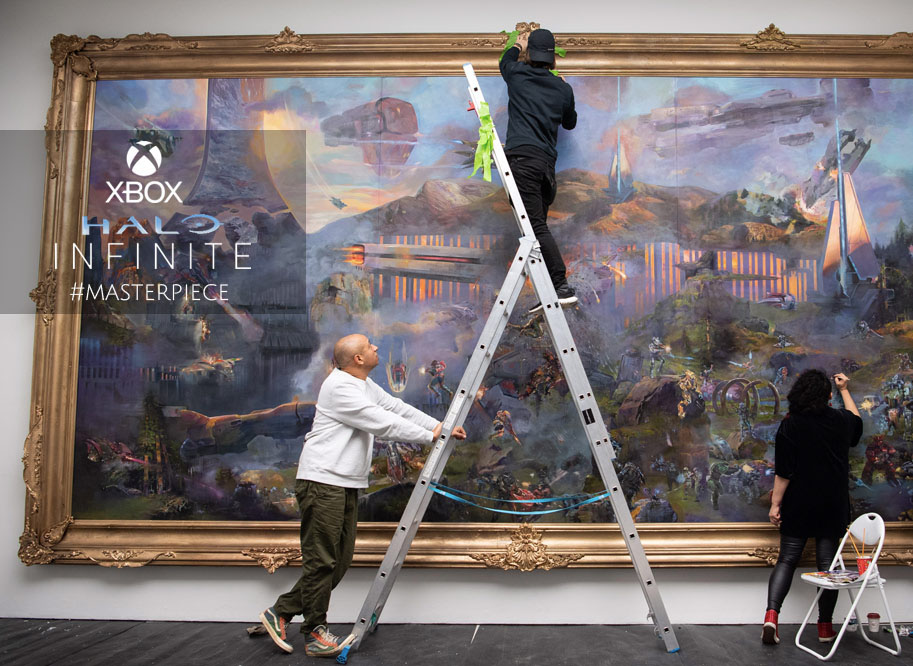
The Halo Infinite Masterpiece represents one of the most extraordinary commissions in recent art history — a collision between the world of fine art and the gaming universe that reached over 520 million people. Iva Troj was challenged to create a work in her own style — ‘which typically has a dreamlike and sometimes fantastical quality’ — while ensuring it was ‘instantly recognisable as Halo.’ The result was months of immersion in Halo’s universe and working alongside the 343 Industries development team’. The painting was completed in just over a month and went on display in Gallery 4 at the prestigious Saatchi Gallery in London, before traveling to The Louvre in Paris. This was no mere commercial commission — it was a testament to how Troj’s art transcends boundaries. Her transparent oil technique, developed over decades, brought a gravitas to the gaming world that it had never before experienced.
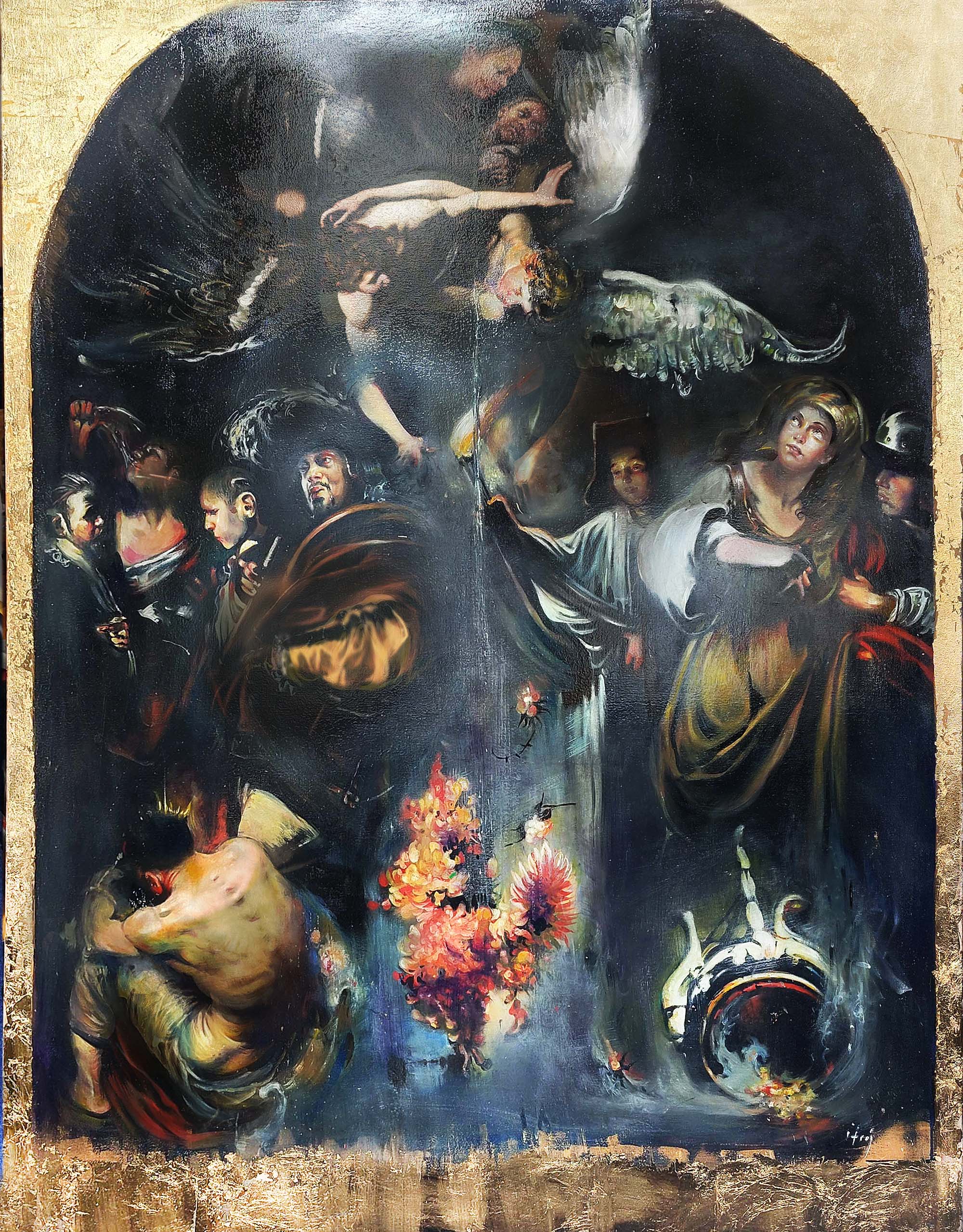
In “Works of Mercy,” Iva Troj bridges the gap between the Baroque and the modern-day, utilizing a masterful blend of oil and gold leaf to sanctify the mundane. Inspired by Caravaggio’s radical legacy—the first to cast “commoners” as saints—Troj collaborated with Myriad Face and Sylvia McGregor to cast Sussex’s own “everyday heroes” as the subjects of this contemporary altar.
The painting is a deliberate homage to Caravaggio’s muralistic scale and dramatic chiaroscuro, maintaining a traditional composition to serve as a literal blueprint for a future church mural. Within this saturated visual language, every gesture is a piece of hidden symbolism, elevating the labor of charity workers and local advocates to the level of the divine. The gold leaf acts as a halo for the unsung, proving that the “Works of Mercy” are not distant historical myths, but living, breathing acts of grace performed by the people walking beside us.
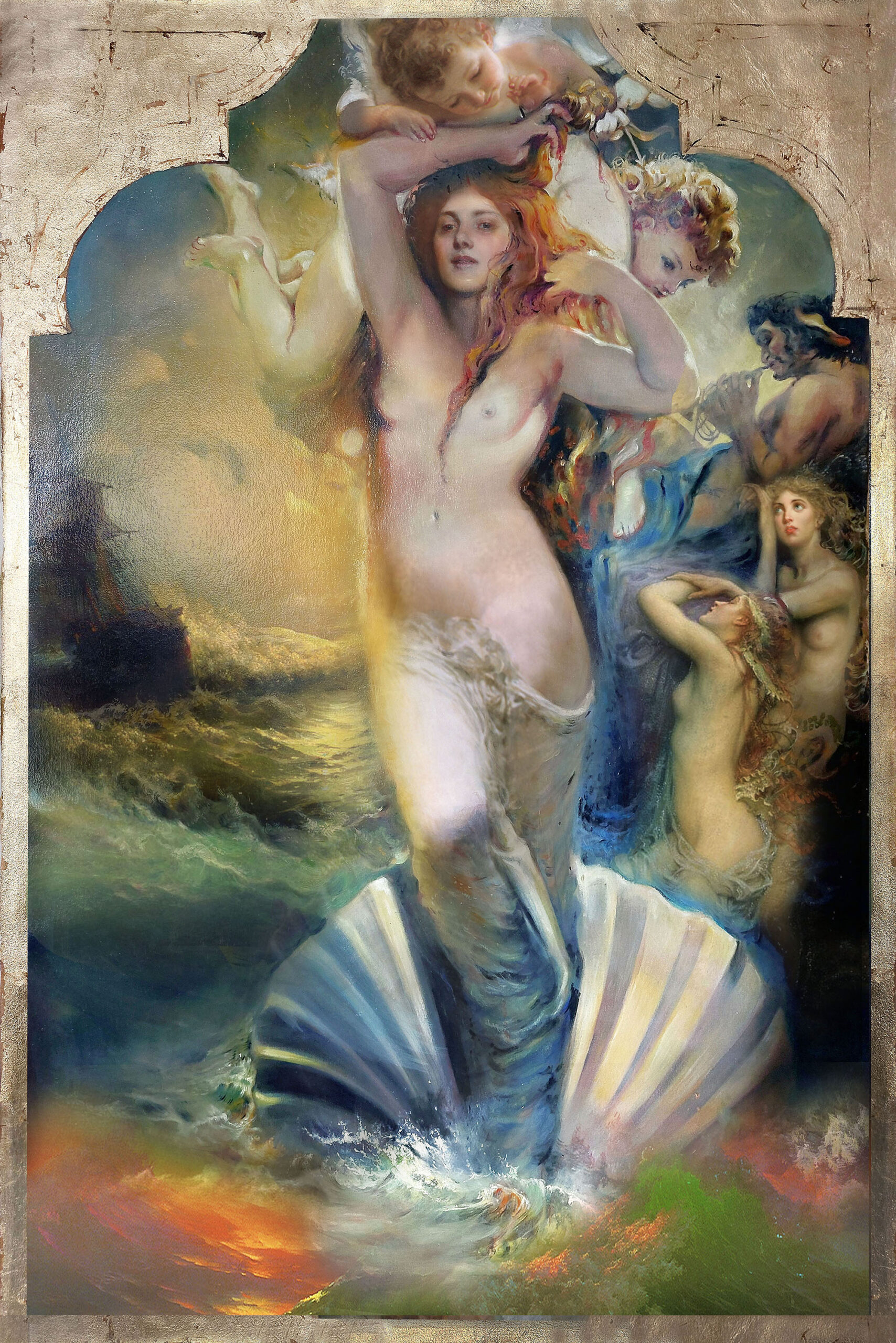
In “Birth of Venus” (Venus Rising), Iva Troj reclaims one of the most exhausted icons of Art History, stripping away the passive, decorative shell of the Botticellian tradition. In this large-format oil painting, Venus does not merely “appear” on a shoreline; she rises with a visceral, grounding force that speaks to the labor of becoming.
Utilizing her signature Flemish layering, Troj imbues the goddess’s form with a luminous, porcelain depth that feels both ancient and startlingly contemporary. The scale of the canvas allows for a densely textured environment where nature is not a backdrop, but an active participant in the deity’s emergence. This Venus is a study in sovereignty and self-creation; she is a figure of quiet, formidable power who possesses her own gaze. By subverting the “male gaze” of the Renaissance, Troj transforms the birth into a monumental allegory of feminine agency.
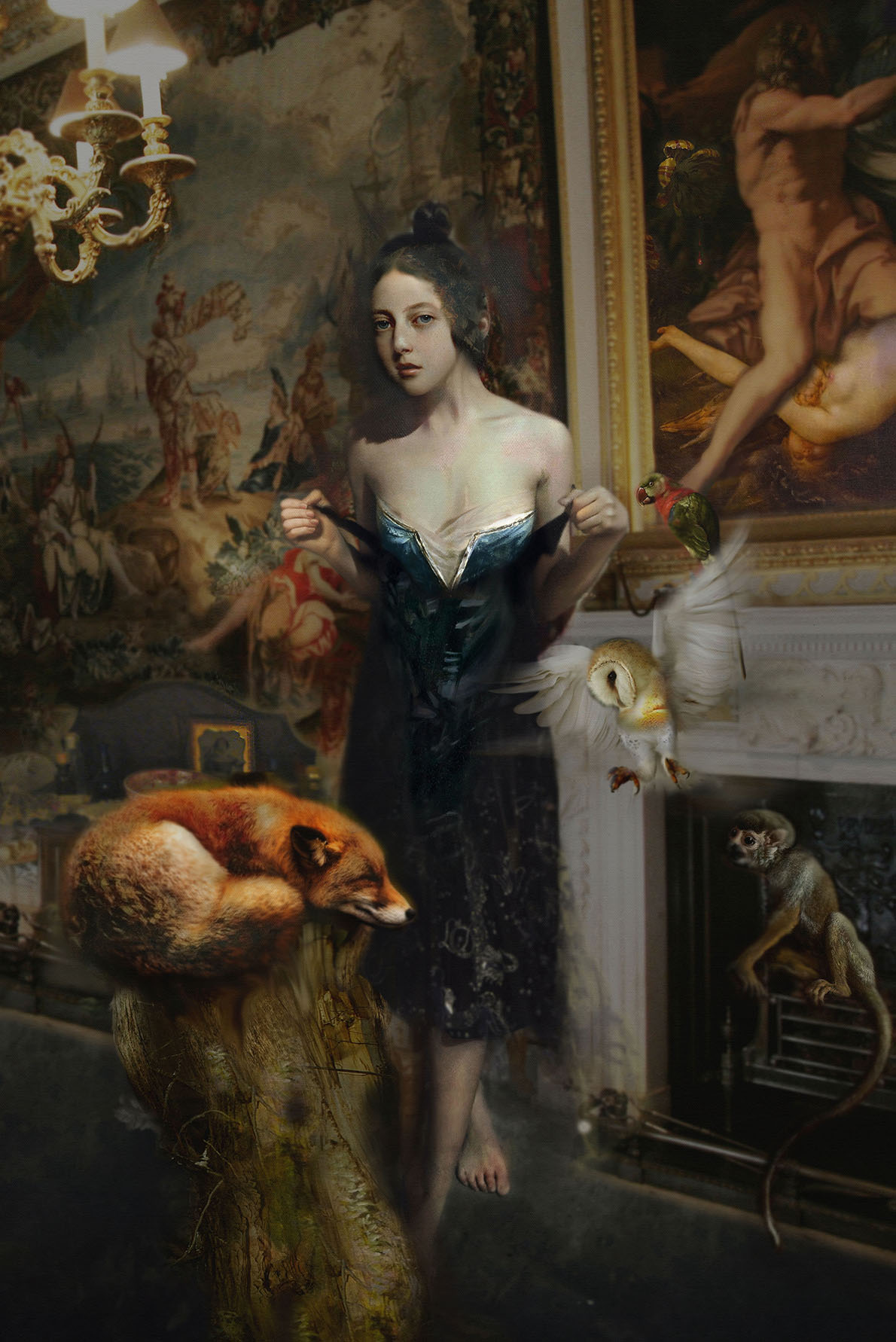
“What Gives” – oil, acrylic, pastel, painting on canvas – blending classical, renaissance figures with modern, often chaotic, or surreal elements, reflecting themes of complex, unresolved human relationships and, sometimes, the loss of innocence.
First exhibited in Tokyo Contemporary as a part of a series exploring the “normalisation of dysfunctional discourses”.
Part of a PRIVATE COLLECTION. London, UK.
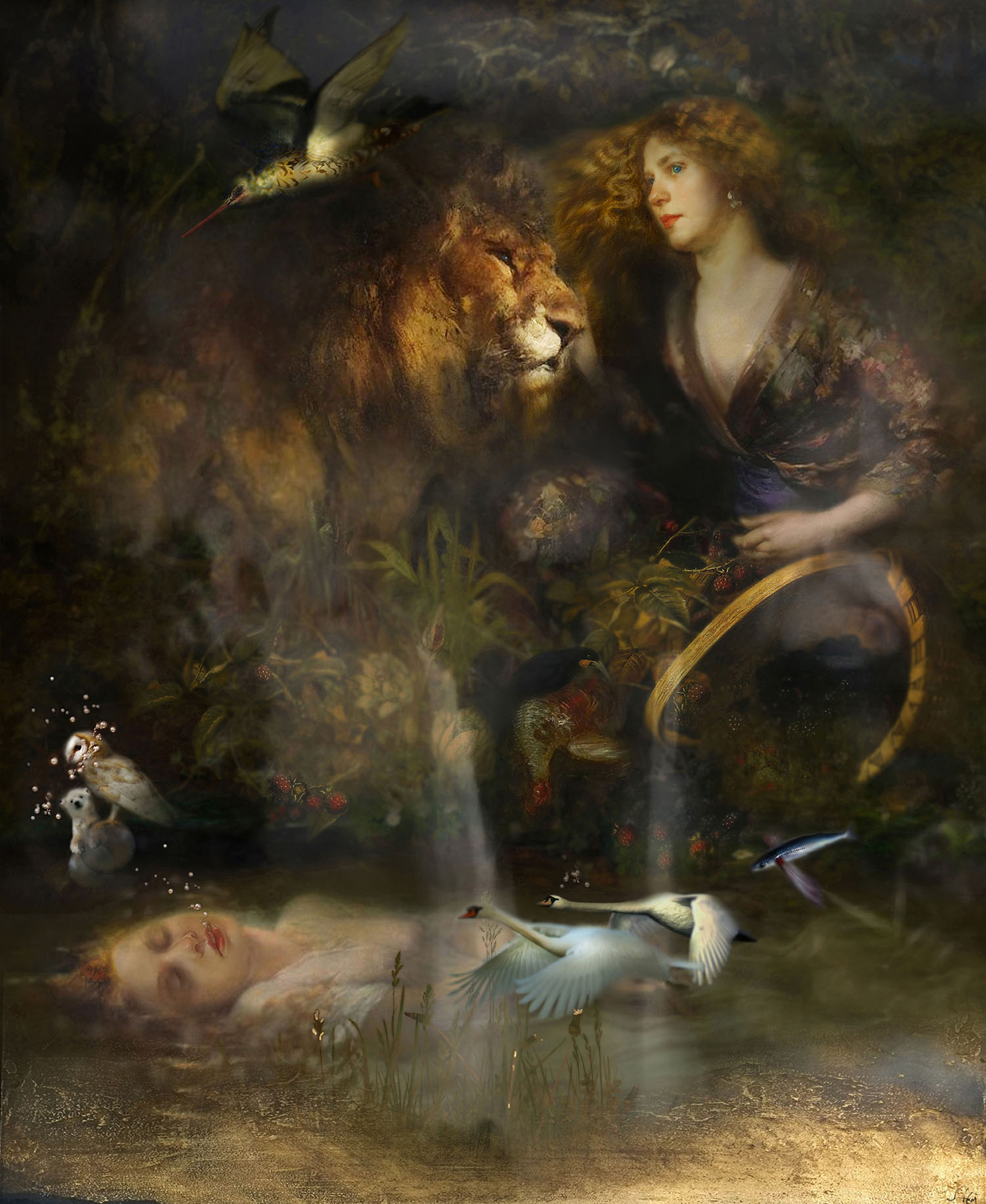
“Water Under No Bridge” – Original Painting – acrylic & oil on canvas – a thematic exploration of memory, identity, and personal narrative.
“Water Under No Bridge” is part of a body of work that explores deeply personal, sometimes painful, memories. This painting series is noted for its “unapologetic” style, often blending historical references with contemporary, personal experiences.
Part of a PRIVATE COLLECTION. USA.
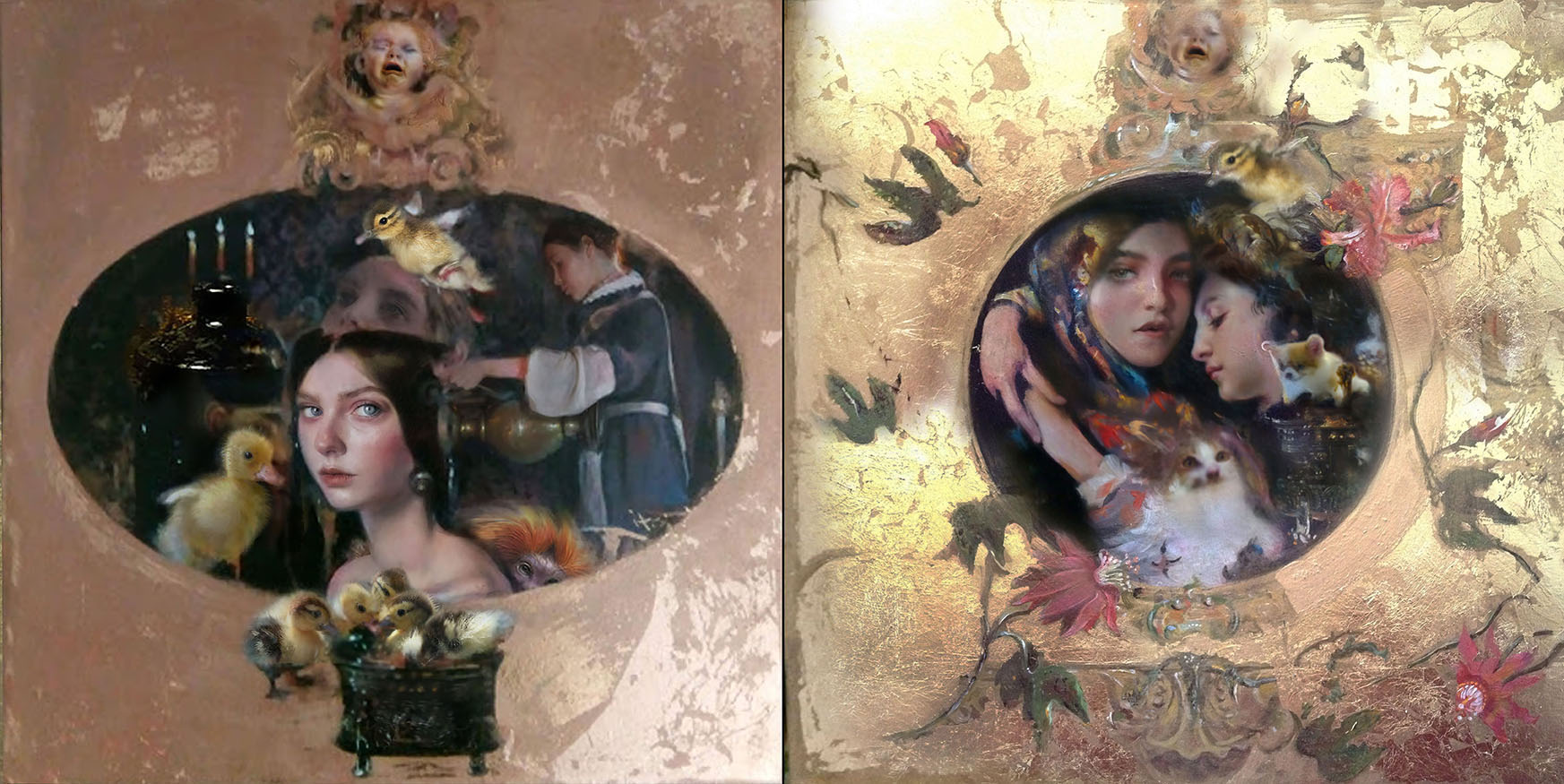
“Water” & “No Man” Diptych – acrylic & Gold Leaf on wood – part of the “Embrace” painting series. First exhibited at Outré Gallery in Melbourne, Australia, as part of “Vanguard” exhibit. “Embrace” features often dreamlike imagery, frequently exploring themes of human connection and emotional vulnerability, utilizing intricate techniques to create layered, highly detailed scenes.
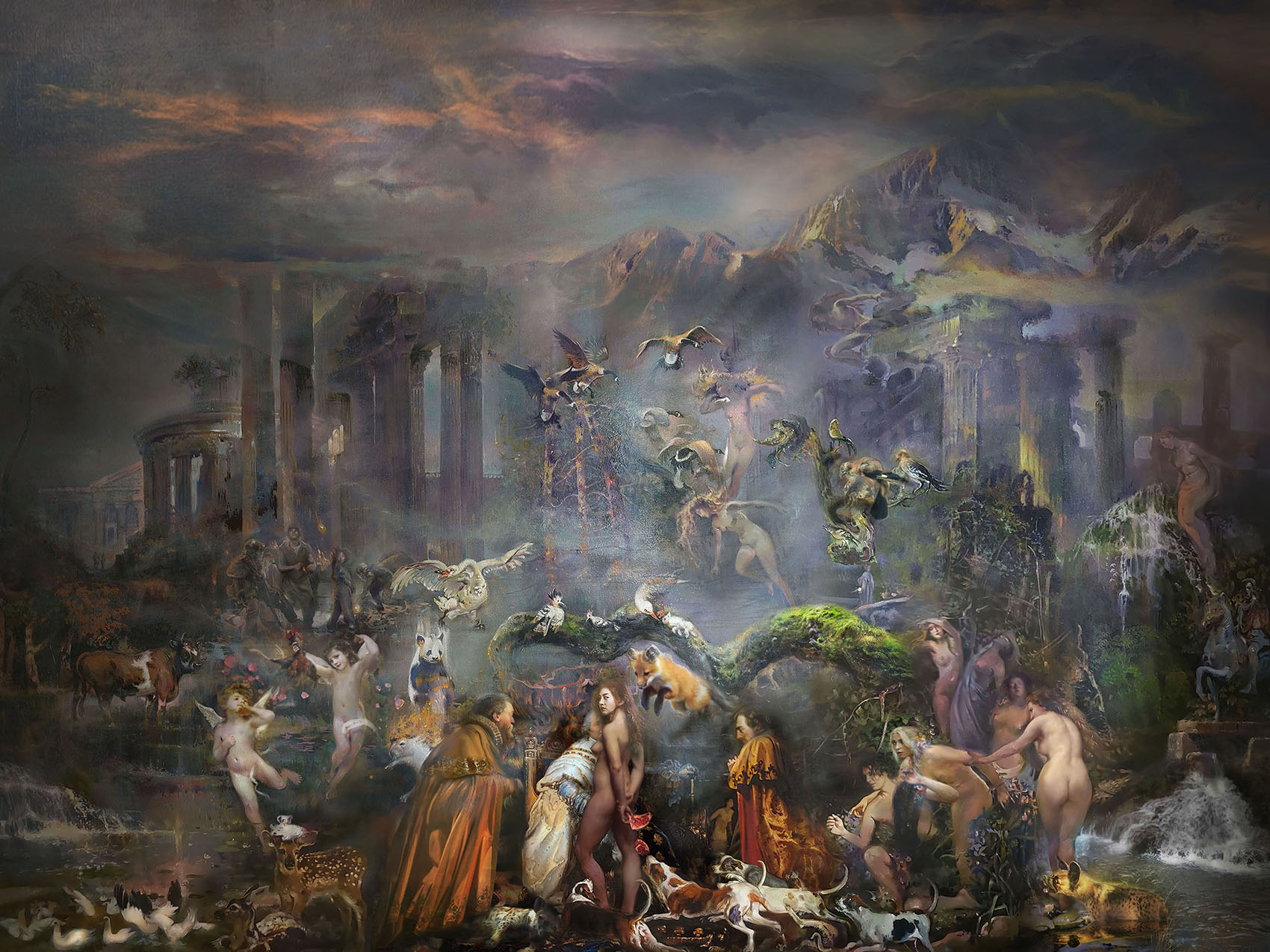
“Barefoot” is a large format oil on canvas painting created specifically for Troj’s Louvre Museum exhibit in 2022. It is inspired by the “Halo Infinite Masterpiece” Iva painted for XBox UK in 2021. It explores the concept of intimacy, femininity and their relationship to power. It is currently on display at Galerie MixArt, Brussels, Belgium,
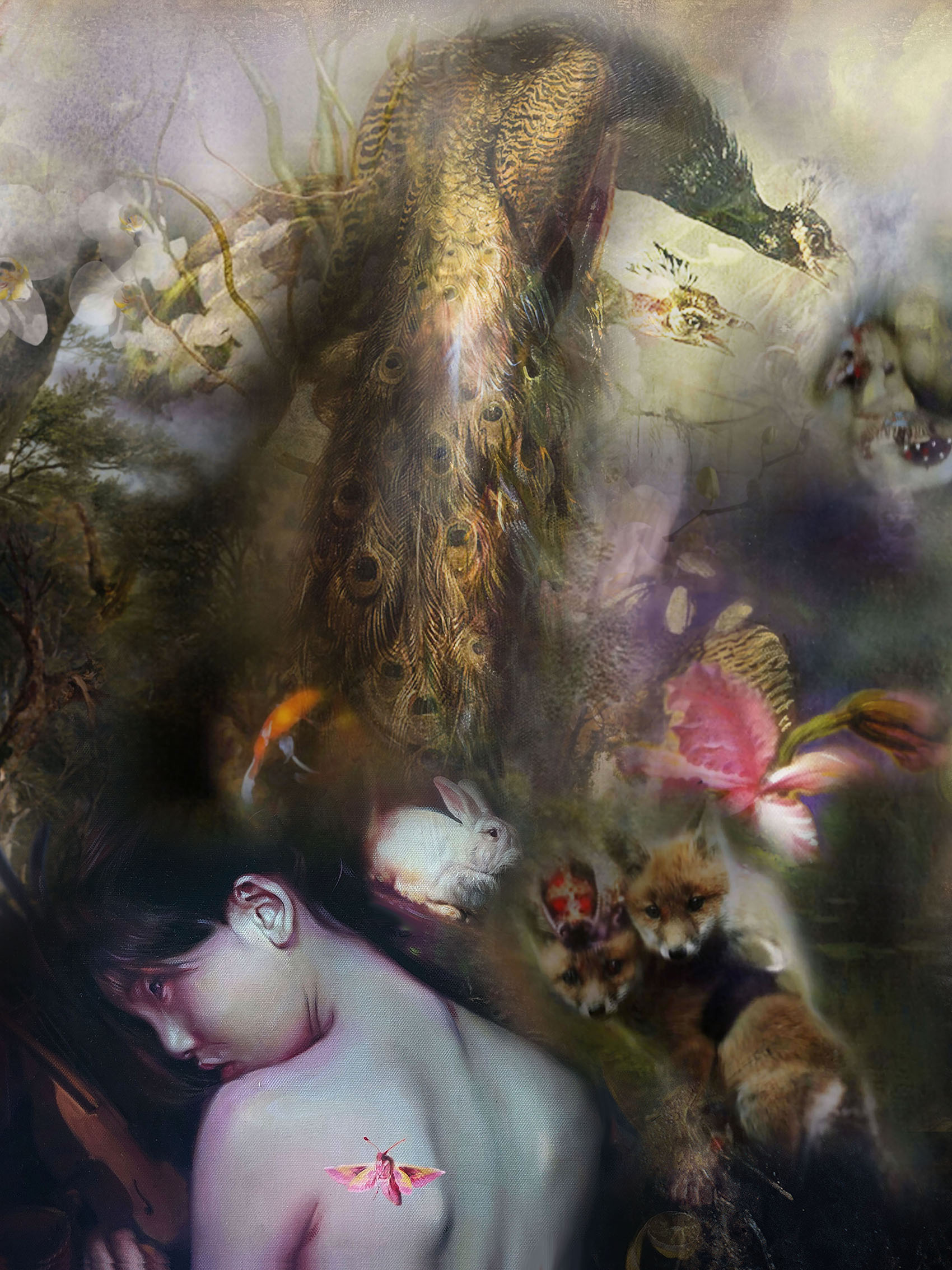
In “Brother,” Iva Troj transitions from the grand political to the profoundly personal, offering a poignant meditation on grief following the loss of her younger brother at the age of thirteen. The painting functions as a sacred space for mourning, where the overwhelming weight of childhood loss is softened by the presence of the natural world. Here, the meticulously rendered animals and birds are not merely decorative—they act as spiritual anchors, symbolizing the visceral need to ground oneself when the world feels untethered by tragedy. Through Troj’s mastery of light and form, the composition suggests that while death is an absolute departure, the companionship of the earth’s creatures provides a path toward equilibrium, weaving a narrative of quiet survival and enduring connection.
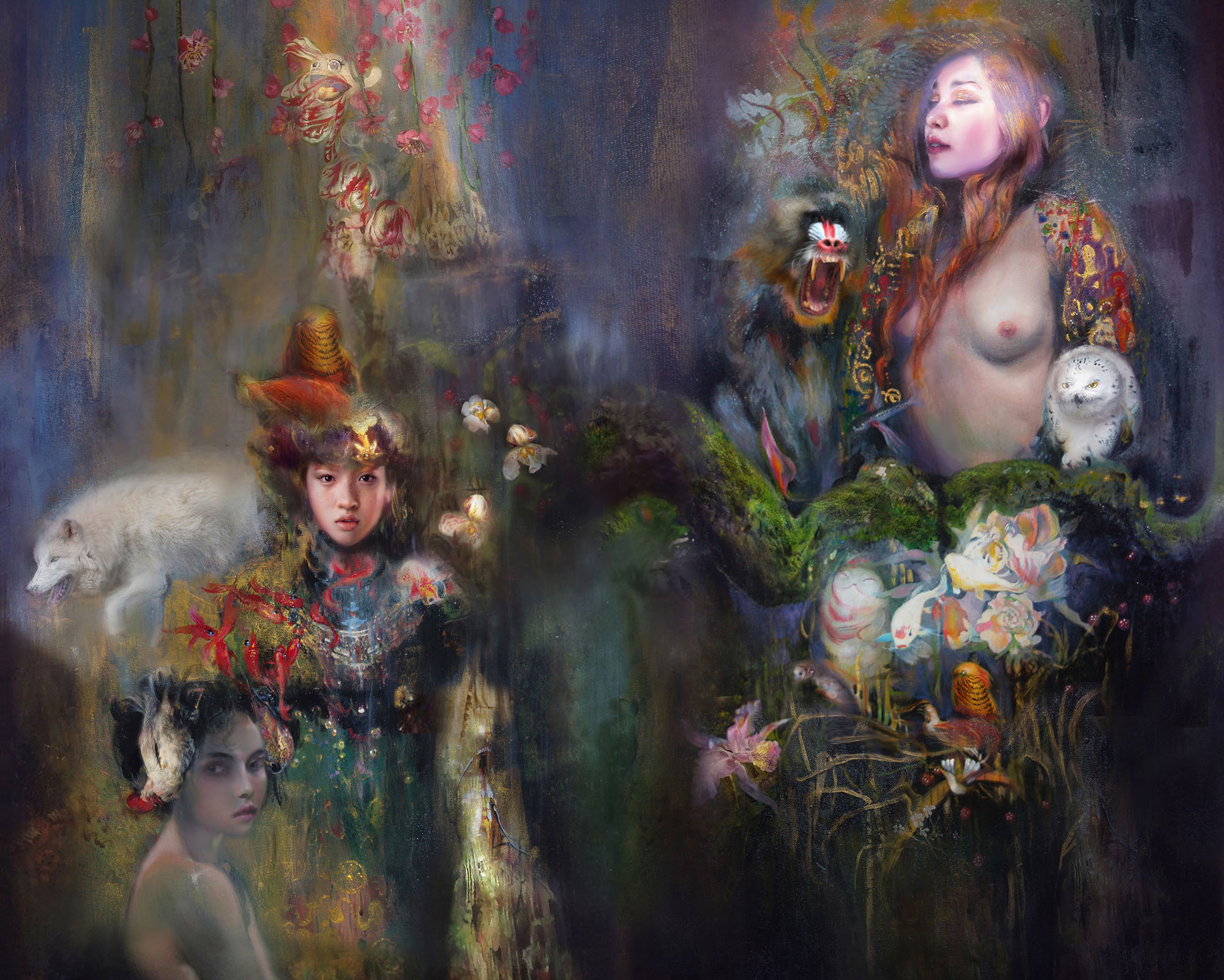
In the “Bride” series, debuted as part of the “Sleeps With Anything But Love” exhibition at The DAE Gallery in Los Angeles (September 2019), Iva Troj employs a lush Rococo aesthetic to navigate the turbulent waters of trauma and resilience. These portraits serve as a profound meditation on standing one’s ground amidst total destruction, capturing the precise moment where the temptation of vengeance meets the grace of restraint. While the ornate, frilled surfaces suggest a classical delicacy, the underlying narrative is one of fierce survival; Troj depicts the internal struggle to resist the seductive pull of anger, choosing instead the quiet power found in authorship of one’s own story. By recontextualizing the “bride” figure—traditionally a symbol of transition and vulnerability—Troj transforms her into a monument of self-possession who finds peace not through external conquest, but through the creation of a transformative personal history.
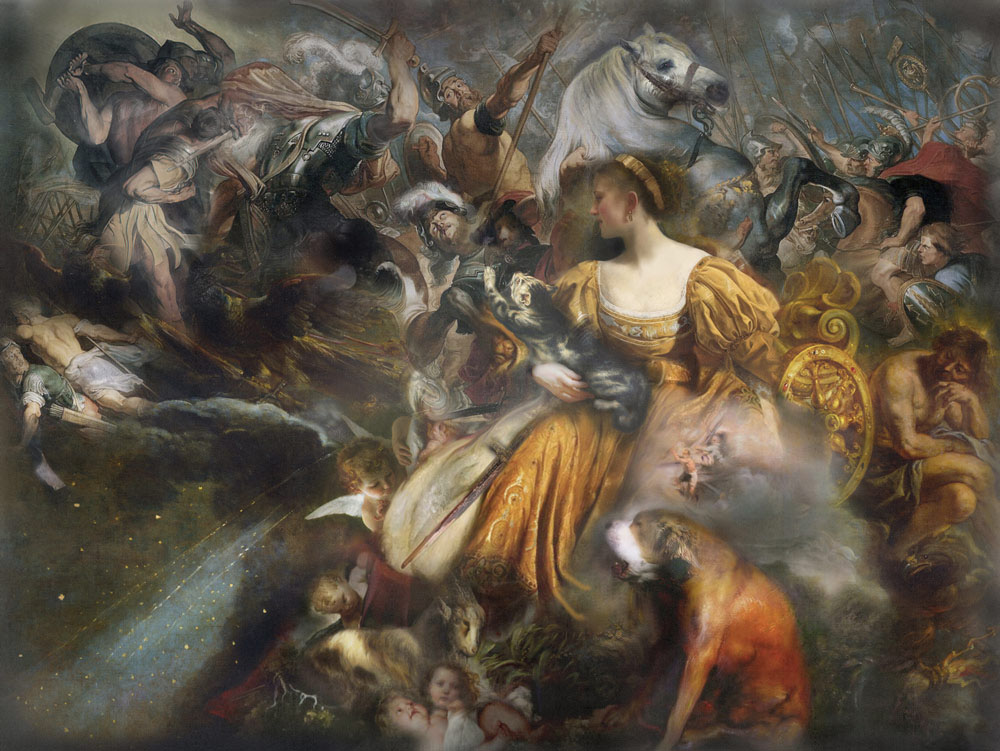
Following the success of the first “Dethroned” diptych, Troj’s “Dethroned II” offers a nuanced exploration of gendered power dynamics. While art history from the Renaissance to the Modern era often framed femininity as subversive to the masculine ideal, Troj’s work reclaims this agency. Her use of Rubensian aesthetics acts as a pointed critique of the contemporary trend to sanitize art history by censoring “voluptuous” forms. The technical mastery — the glazing, the luminous skin tones, the depth of shadow — creates an almost sacred quality, as if this defender has stepped out of a Renaissance altarpiece into our modern world.
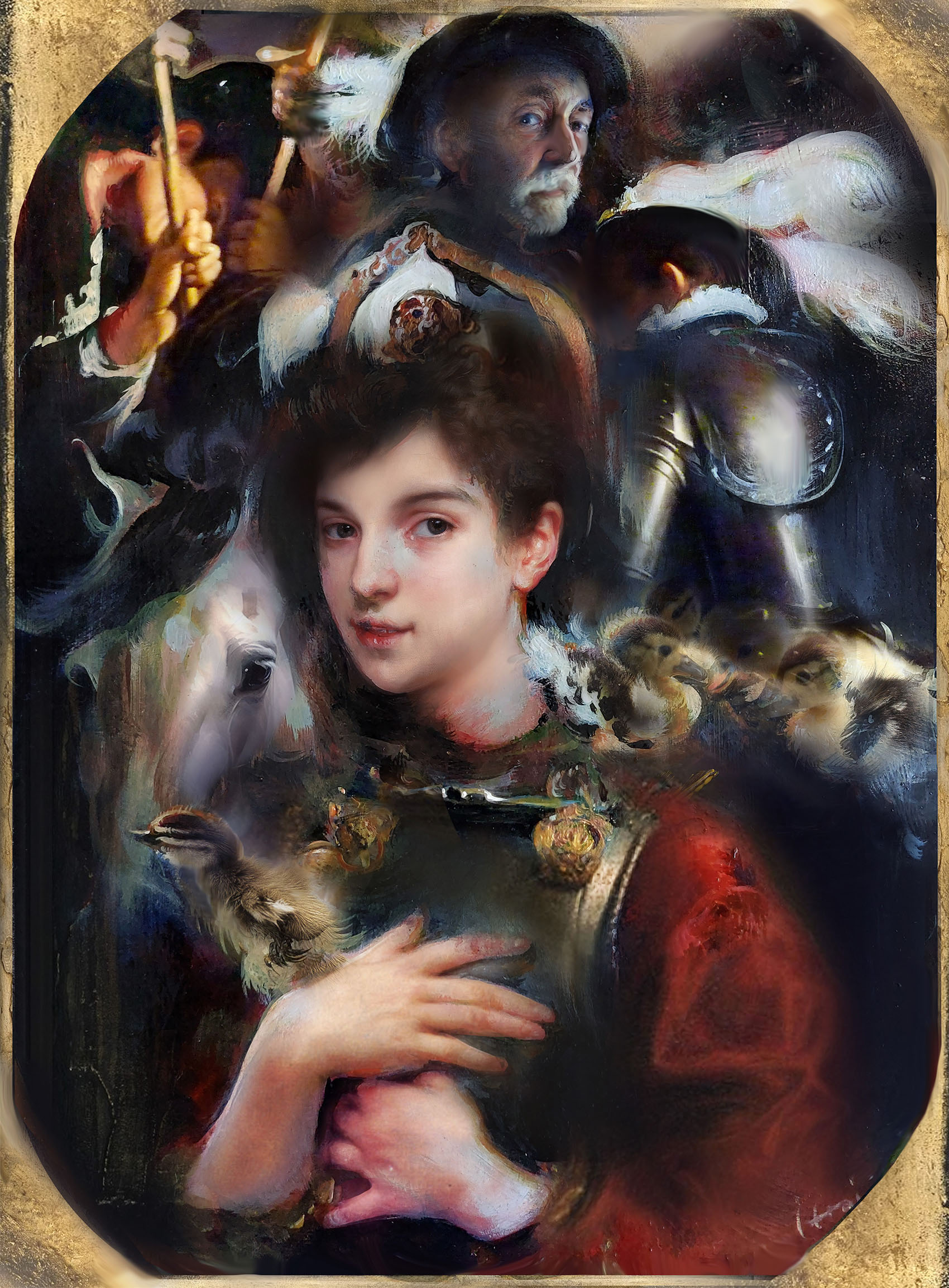
In ‘Defender Of Small Things’, Iva Troj continues her lifelong exploration of power dynamics and vulnerability. The painting exemplifies her transparent oil technique, also known as the Flemish Method, which she has reinvented to serve contemporary storytelling. The figure in the painting stands as a guardian — not of kingdoms or empires, but of the overlooked, the fragile, the quietly magnificent. Troj’s work here draws from her Eastern European upbringing, where ‘hymns to machinery superseded humanity and nature fell victim to progress.’ The defender in this painting is a bridge between the summers spent beside her grandmother, amidst hanging gardens and timeless narratives, and the harsh industrial reality of communist Bulgaria.
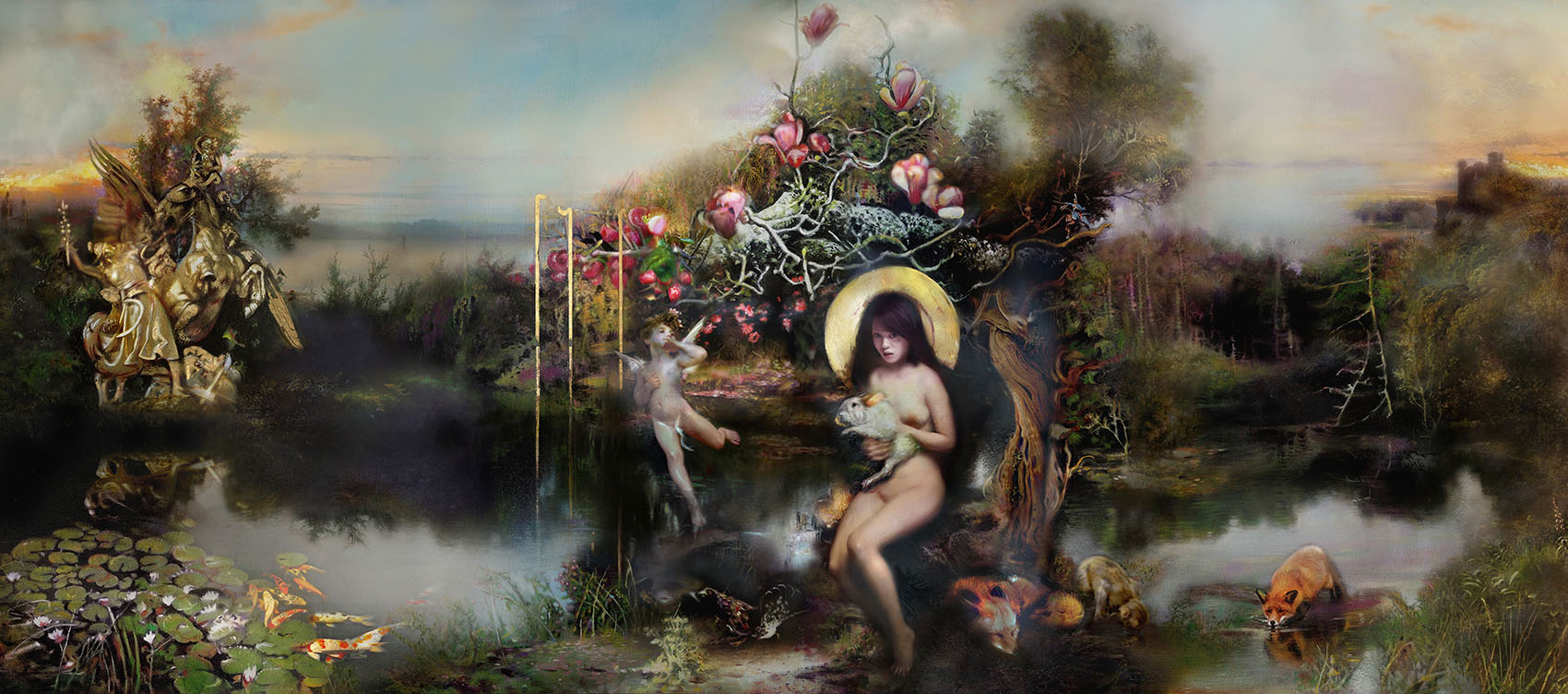
In “Sorry to See You Go,” Iva Troj offers an unflinching and deeply intimate portrait of the raw architecture of loss. The composition centers on a nude, vulnerable figure—stripped of all social armor—sitting in solitary reflection beneath a massive, sprawling tree that teems with indifferent life. Clutched to the figure’s chest is a rabbit, a tender symbol of grounding and fragile comfort in the face of overwhelming grief and fear.
The painting serves as a bridge between the physical and the ethereal, featuring Iva and her late brother as children, or perhaps angels, watching from the periphery. Their presence transforms the scene from a study of isolation into a sanctuary of memory, suggesting that even in the deepest moments of “letting go,” we are never truly unobserved. By contrasting the singular, exposed human form with the ancient, vibrant energy of the tree, Troj captures the paradoxical nature of grief: the feeling of personal extinction occurring within a world that refuses to stop blooming.
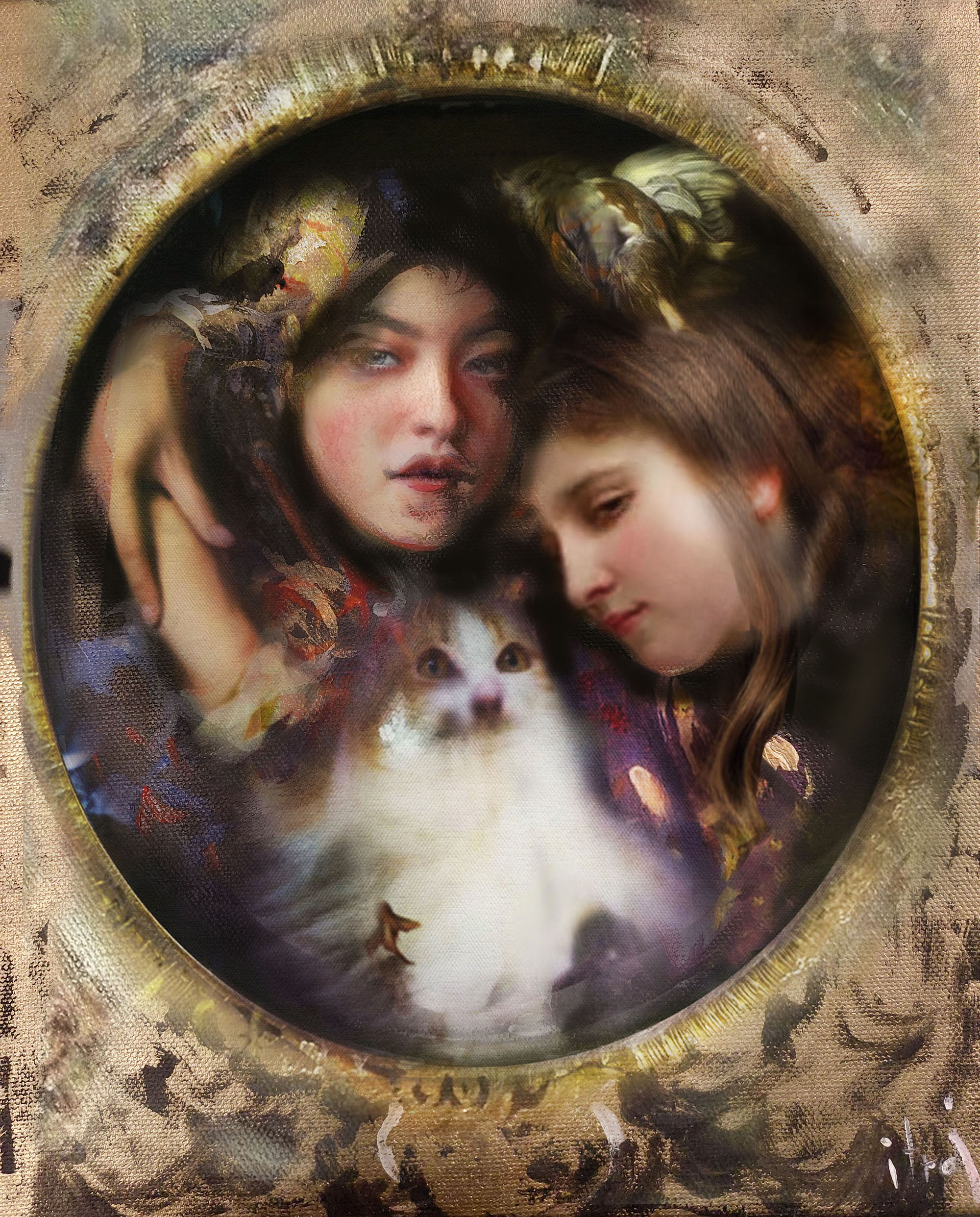
In “Sisters II,” Iva Troj evolves the contemplative solitude of the “No Man” series into a monumental testament to collective resilience. This oil painting serves as a profound dual portrait, capturing the artist and her sister in an embrace that transcends mere affection; it is a visual manifestation of shared strength and the weight of having each other’s lives held in their hands.
Building on the aesthetic language of “No Man,” the work utilizes a rich, dramatic palette to highlight the tactile reality of their bond. The composition rejects the traditional “passive” depiction of women in classical art, instead presenting the sisters as each other’s primary support system—a fortress of two. Through her signature layering of fine glazes, Troj imbues the figures with a luminous, marble-like durability, suggesting that while their individual vulnerabilities remain, their union creates an unbreakable architecture of survival.
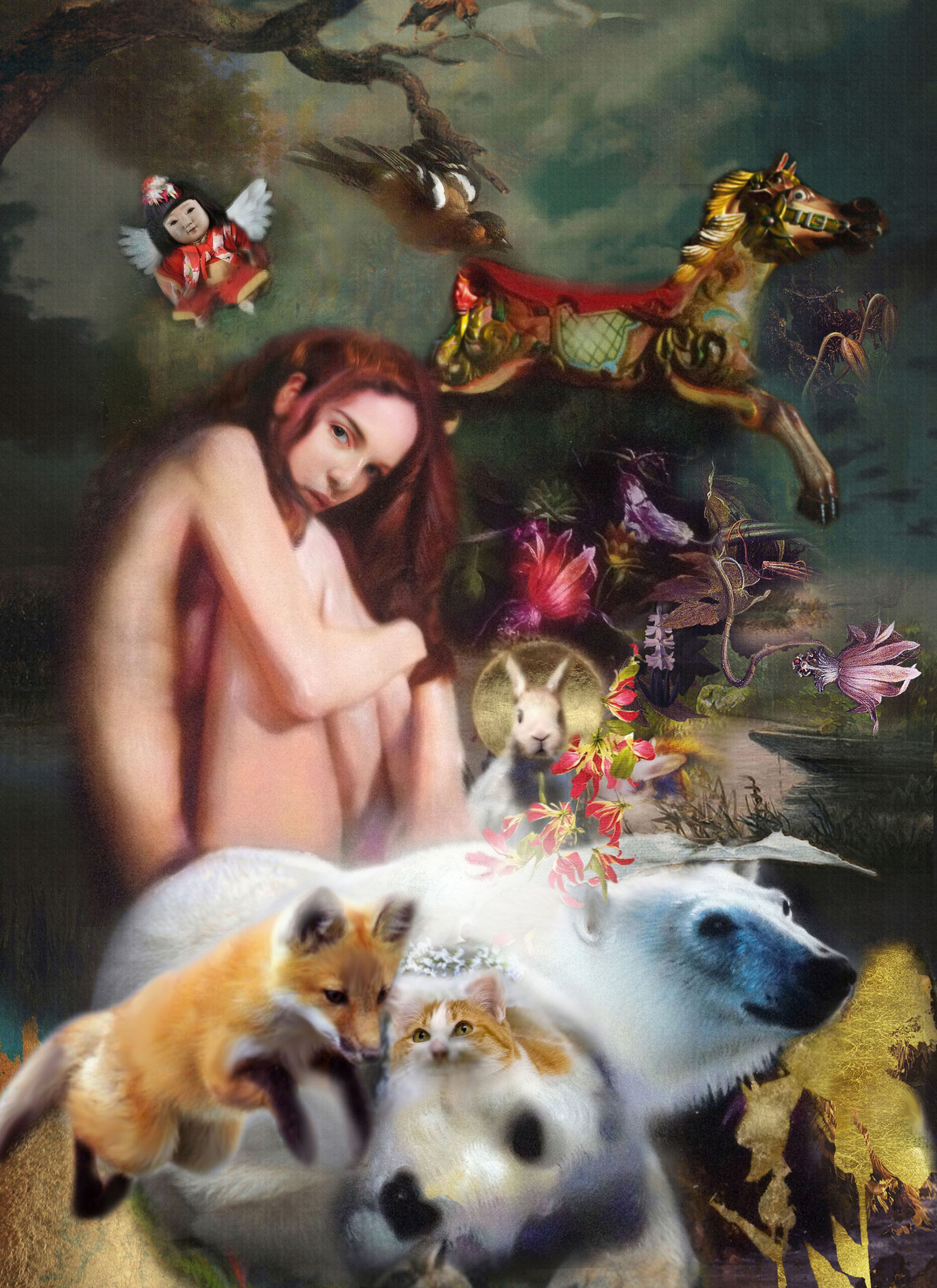
In “Milk,” Iva Troj subverts one of art history’s most enduring symbols of nurturance, transforming it into a visceral meditation on sustenance, sacrifice, and the raw mechanics of survival. The painting strips away the pastoral serenity usually associated with the motif, replacing it with a charged, almost supernatural tension that highlights the heavy toll of giving oneself to another.
Through the luminous, translucent layers of the Flemish method, the “milk” becomes more than a physical substance—it is a liquid light, a carrier of memory and DNA. The central figure is depicted not as a passive vessel, but as a source of profound, quiet power, navigating the delicate balance between the drain of exhaustion and the divinity of provision. In Troj’s hands, this infamous work becomes a sanctuary where the act of feeding is reclaimed as a warrior’s duty, proving that the most fundamental human connections are often forged in the beautiful, painful crucible of necessity.
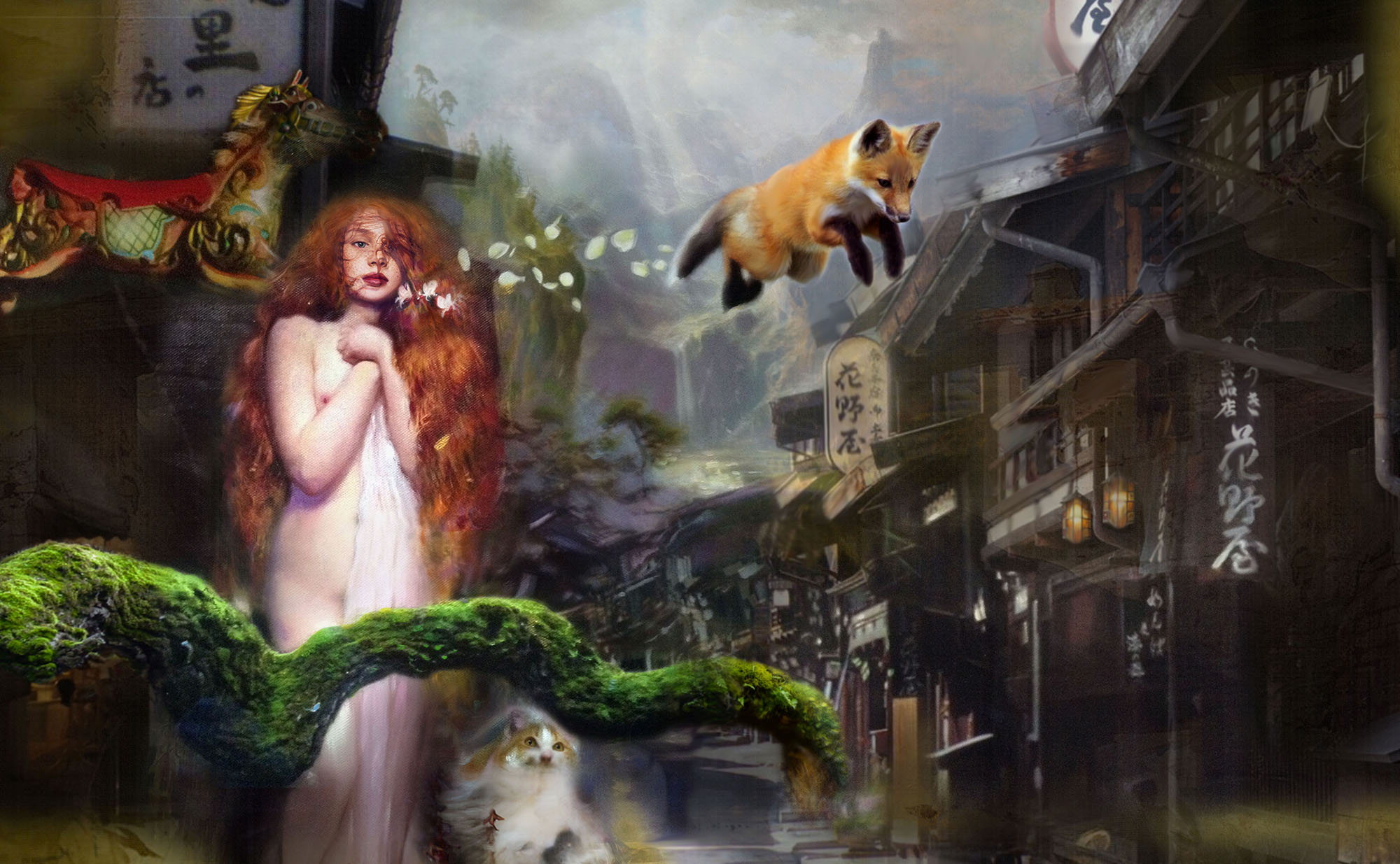
In “Fields,” Iva Troj orchestrates a sprawling, multi-layered narrative that captures the intersection of human history and the indifferent beauty of the natural world. This expansive oil painting functions as a topographical map of the soul, where figures are sown into the landscape like memories, emerging from and receding into the earth through Troj’s masterful use of Flemish glazing.
The work explores the concept of the “field” not just as a physical space, but as a site of harvest, battle, and rebirth. Within this dense composition, the traditional boundaries between the individual and the environment dissolve; the golden hues and earthy undertones suggest that we are both the cultivators and the crop. Through her signature subversion of classical motifs, Troj reimagines the pastoral as a complex psychological terrain—a place where the “fields” of our past are constantly being tilled to make room for the metamorphosis of the future.
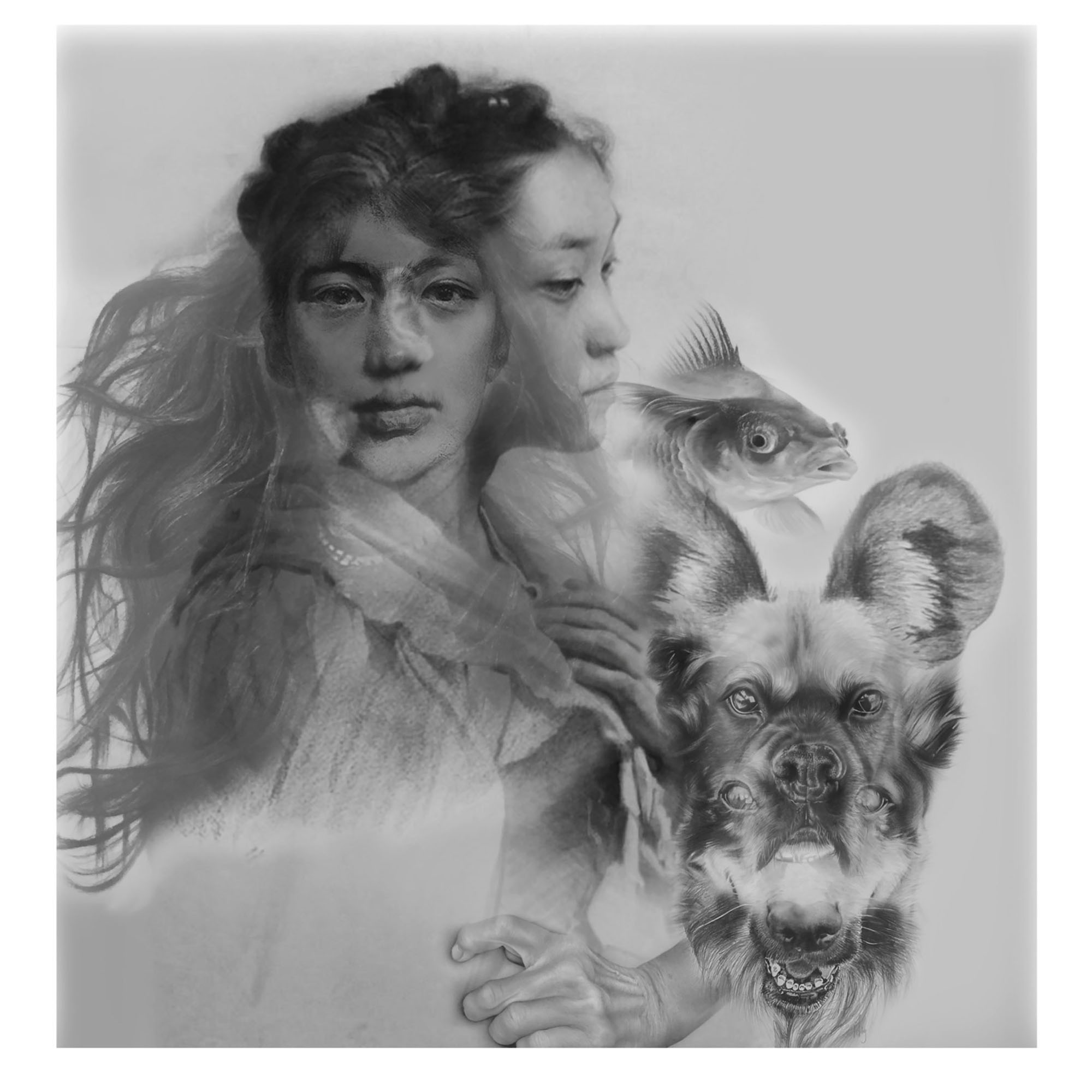
In the pencil drawing “Siblings”—the foundational sketch for the Sisters series—Iva Troj strips away the opulence of oil to reveal the raw, structural integrity of kinship. Executed with a visceral precision, this work captures the primal essence of the sibling bond, focusing on the shared DNA of resilience rather than the decorative trappings of status.
By utilizing the monochromatic intimacy of graphite, Troj highlights the “silent language” between two people who have navigated the same history. The sketch serves as a blueprint for the series’ broader themes: the weight of mutual responsibility and the instinctive way siblings anchor one another against the world.
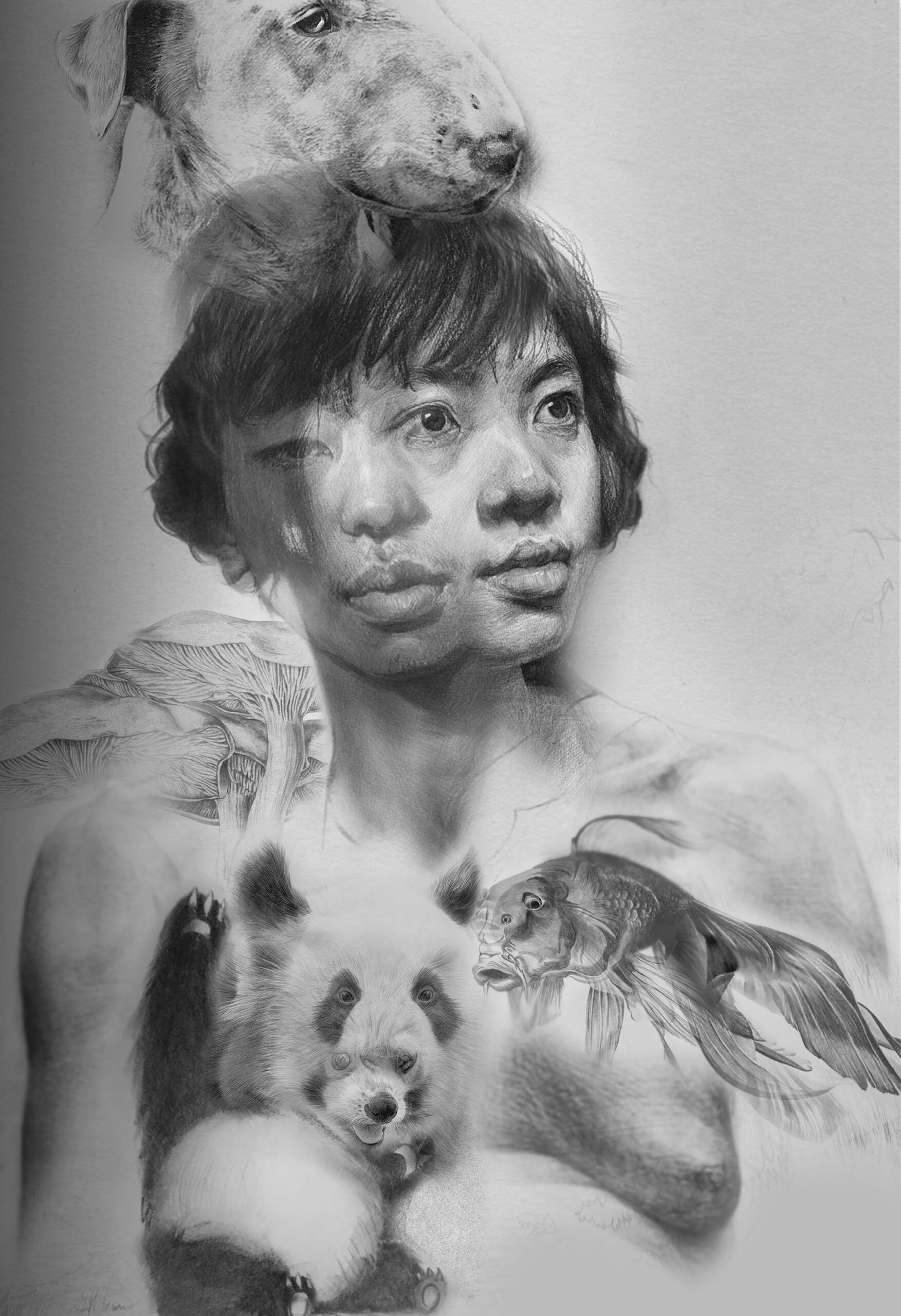
As the inaugural breath in a series of hyperrealistic and surrealist visions, this work marks the beginning of a deep descent into the labyrinth of human nature. It poses the quiet, weightless questions we only ask in the dark: How does the soul speak when it stands unobserved? Who holds the pen that defines us?
In these drawings, the graphite does not merely trace the boundaries of the body; it maps a sanctuary of absolute, shivering trust. Stripped of the deceptive “armor” of color and the varnish of persona, we are left with the raw, silver-etched truth. Here, strength is found not in the fortress, but in the skeletal grace of our most fundamental connections—the unyielding lines that bind us to ourselves and to each other before the world begins to paint over them.
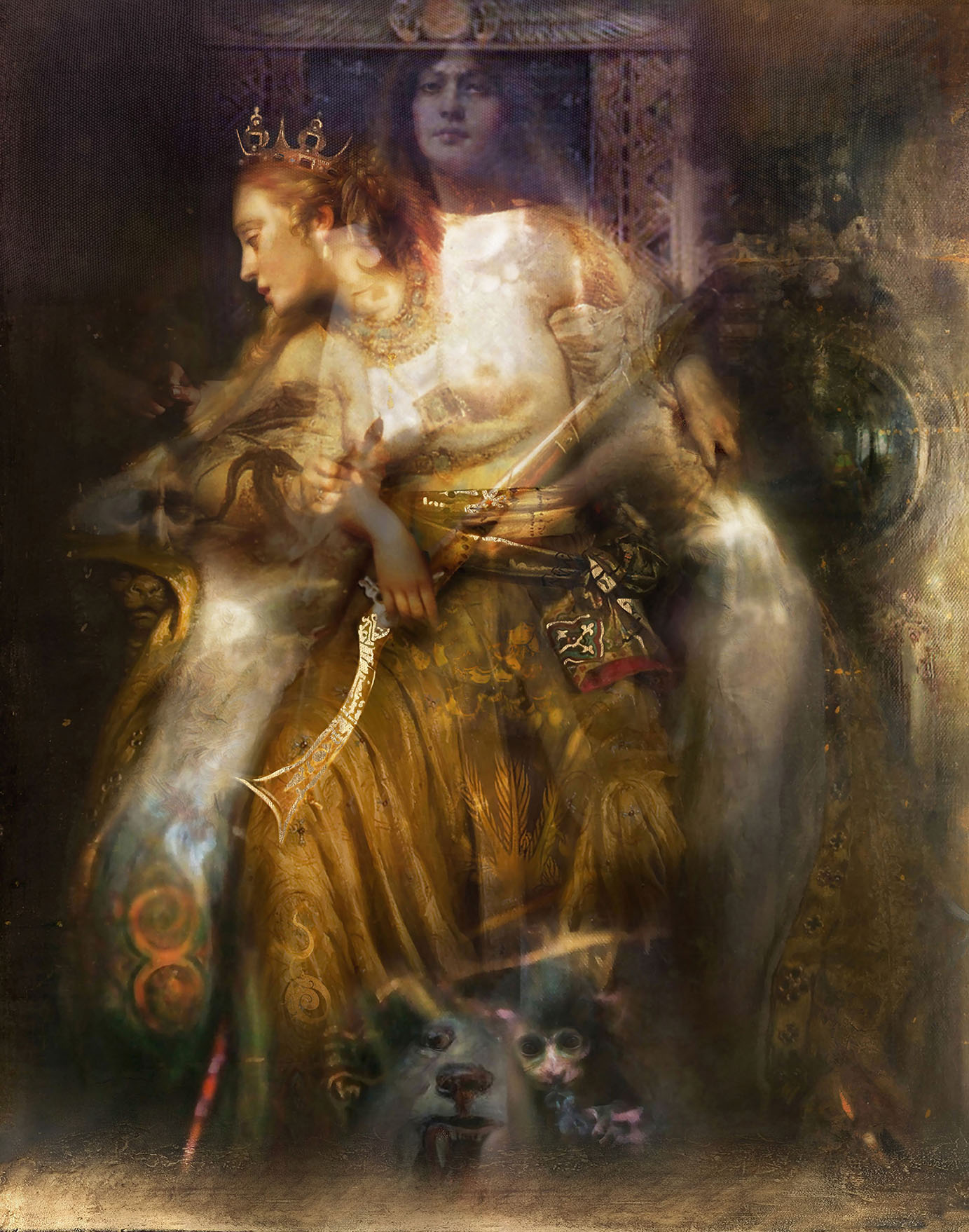
The original “Dethroned” diptych serves as the foundational exploration of Iva Troj’s career-long interrogation of power, gender, and classical iconography. In this ambitious two-panel work, Troj strips away the traditional “throne” of patriarchal art history, replacing the rigid hierarchies of the Renaissance with a fluid, postmodern narrative of female sovereignty. The diptych format itself—historically reserved for religious devotion or royal portraits—is subverted to elevate the “subversive” woman into a figure of monumental importance. Through her signature technical prowess, Troj creates a cinematic tension between the delicate, luminous figures and the vast, often chaotic landscapes they inhabit. This initial “Dethroned” series established the visual language that would define her later works: a world where the feminine is no longer a footnote to manhood, but a primary force of nature, reclaimed from the shadows of the Old Masters.
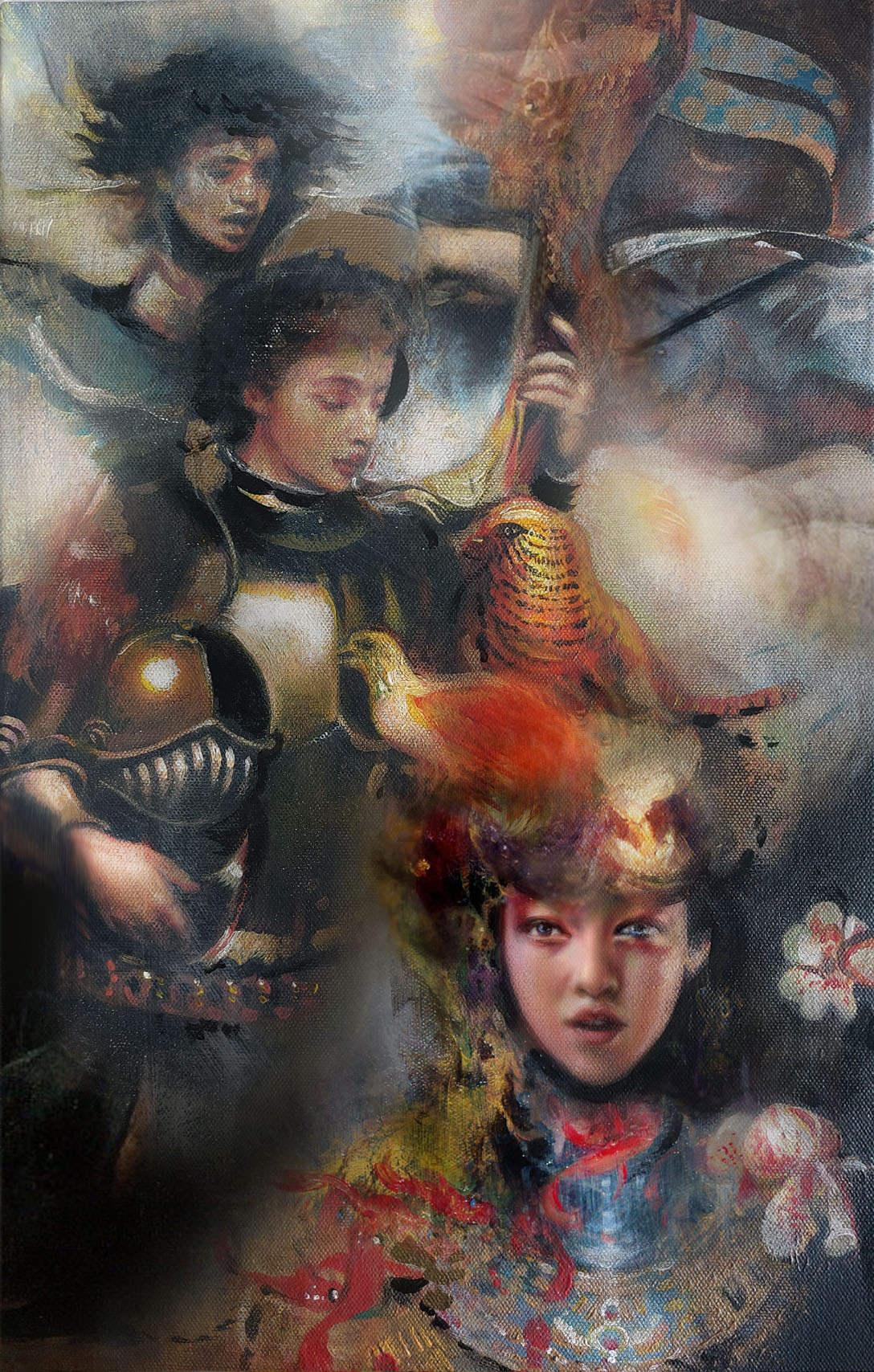
In the sequel to “Defender of Small Things” – “Carrying Joan”, Troj expands her narrative lens from individual protection to the collective strength found in friendship and chivalry. While the original work established the sanctity of the vulnerable, this second chapter explores the active architecture of connection—the “building of bridges” between disparate worlds. Troj employs her characteristic Renaissance-inspired brushwork to depict an evolved form of heroism, one rooted not in conquest, but in the noble labor of understanding and alliance. Through a composition rich with symbolic gestures and shared spaces, the painting suggests that true chivalry in the modern age is the courageous act of reaching out. The luminous atmosphere and intricate detailing serve to sanctify these bonds, elevating simple companionship to a monumental, almost mythic status.
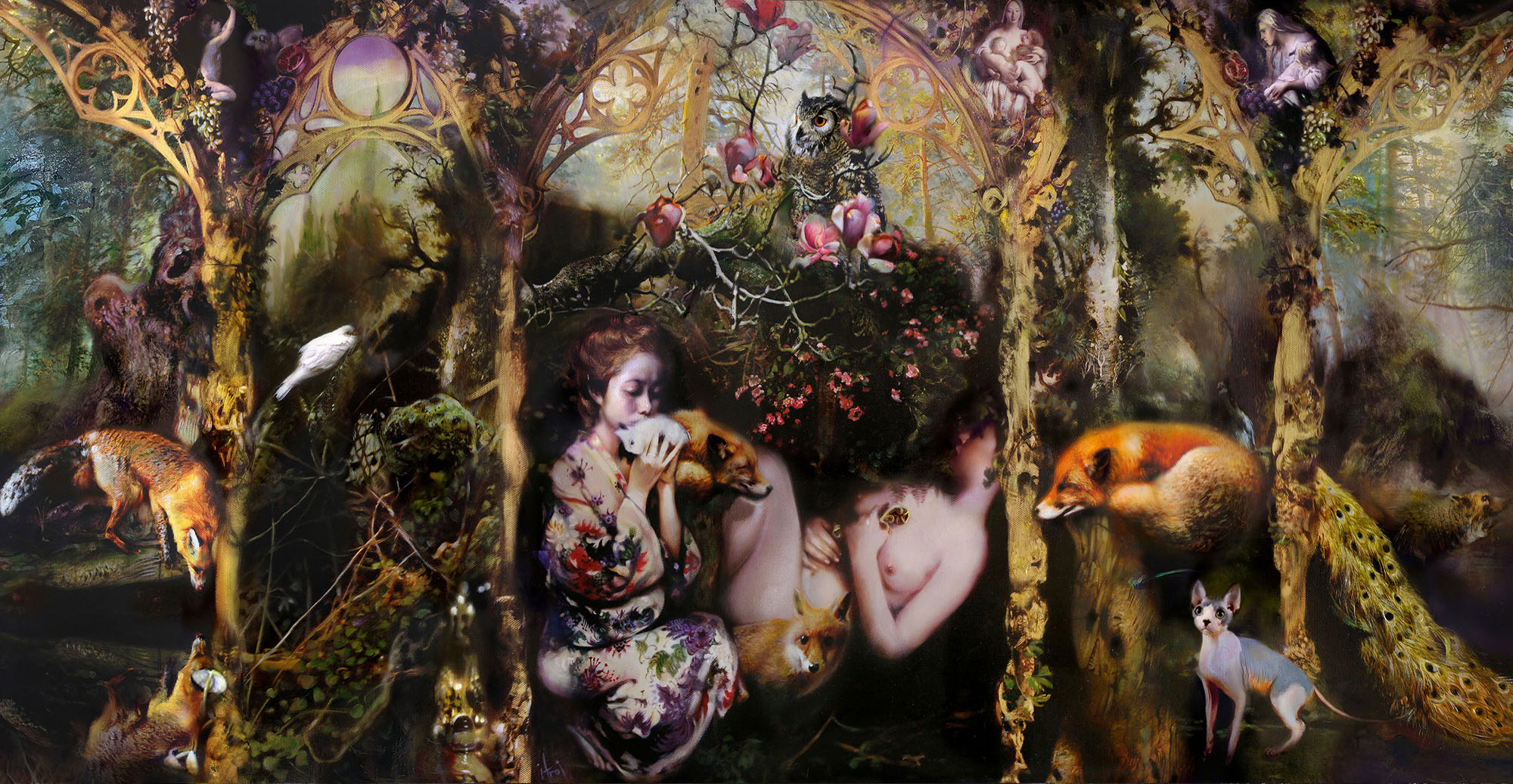
In “Travellers,” an evocative oil on canvas, Iva Troj transcends the literal act of movement to explore the profound architecture of human vulnerability and memory. Rather than depicting a physical relocation, Troj presents her figures as symbolic vessels for the interior journey—capturing the quiet psychological tension that defines the modern state of transition and displacement.
The work is a direct response to a challenge to define intimacy beyond the traditional “coupling” box. By deconstructing the romanticized lens of partnership, Troj reveals the many faces of connection: the shared weight of a collective history and the solitary burden of identity. Her signature mastery of atmosphere lends a weightless, dreamlike quality to the figures, suggesting that our most significant travels are those navigated through the landscape of the soul.
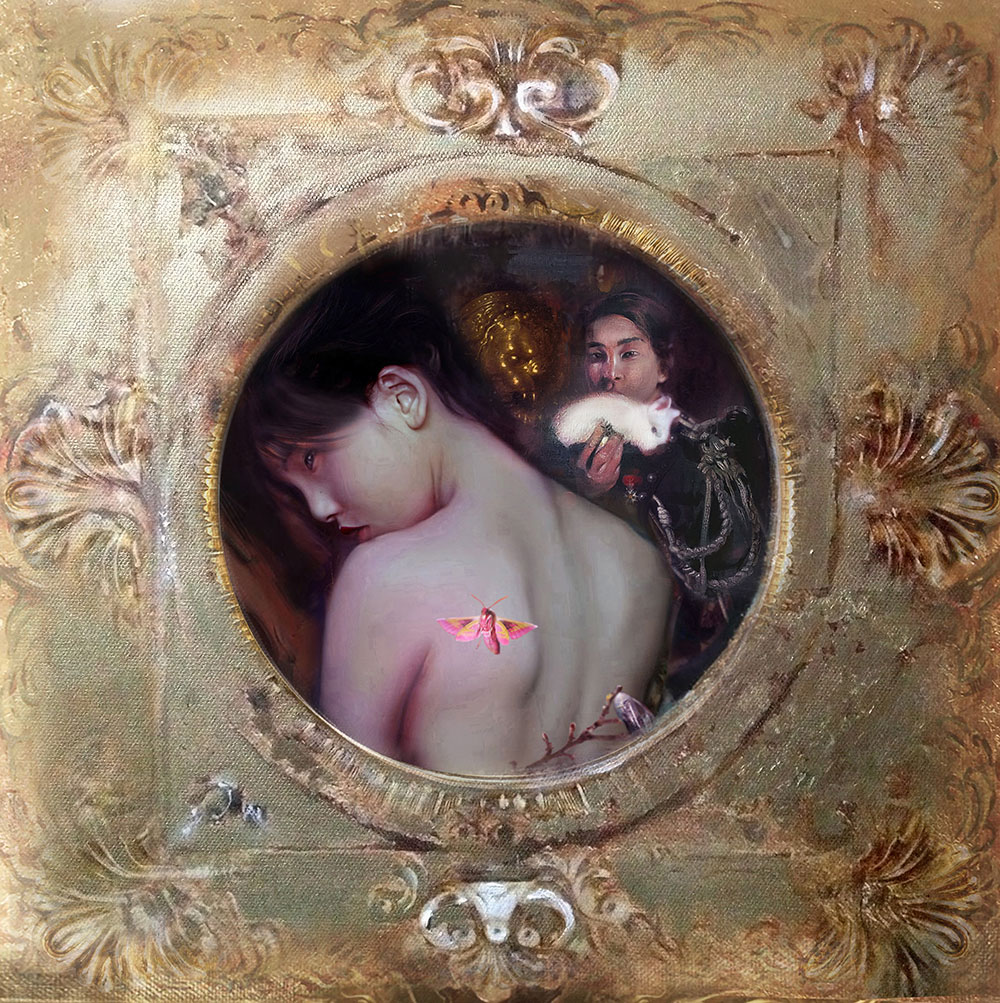
In her first “A Man” portrait, Iva Troj pivots her lens toward a singular ungendered study, meticulously deconstructing the traditional expectations of the “male or female subject.” Rather than projecting outward strength or social dominance, this work is an intimate exploration of grounding and the sanctity of personal space.
Troj utilizes a deliberate, focused composition to capture a rare moment of stillness—a human reclaiming her internal equilibrium. By stripping away the noise of external expectations, the painting highlights the vital necessity of an emotional “home base.” The mastery of light and shadow here doesn’t just define the figure; it carves out a protective boundary, emphasizing that true power is found in the quiet, unyielding possession of one’s own space.
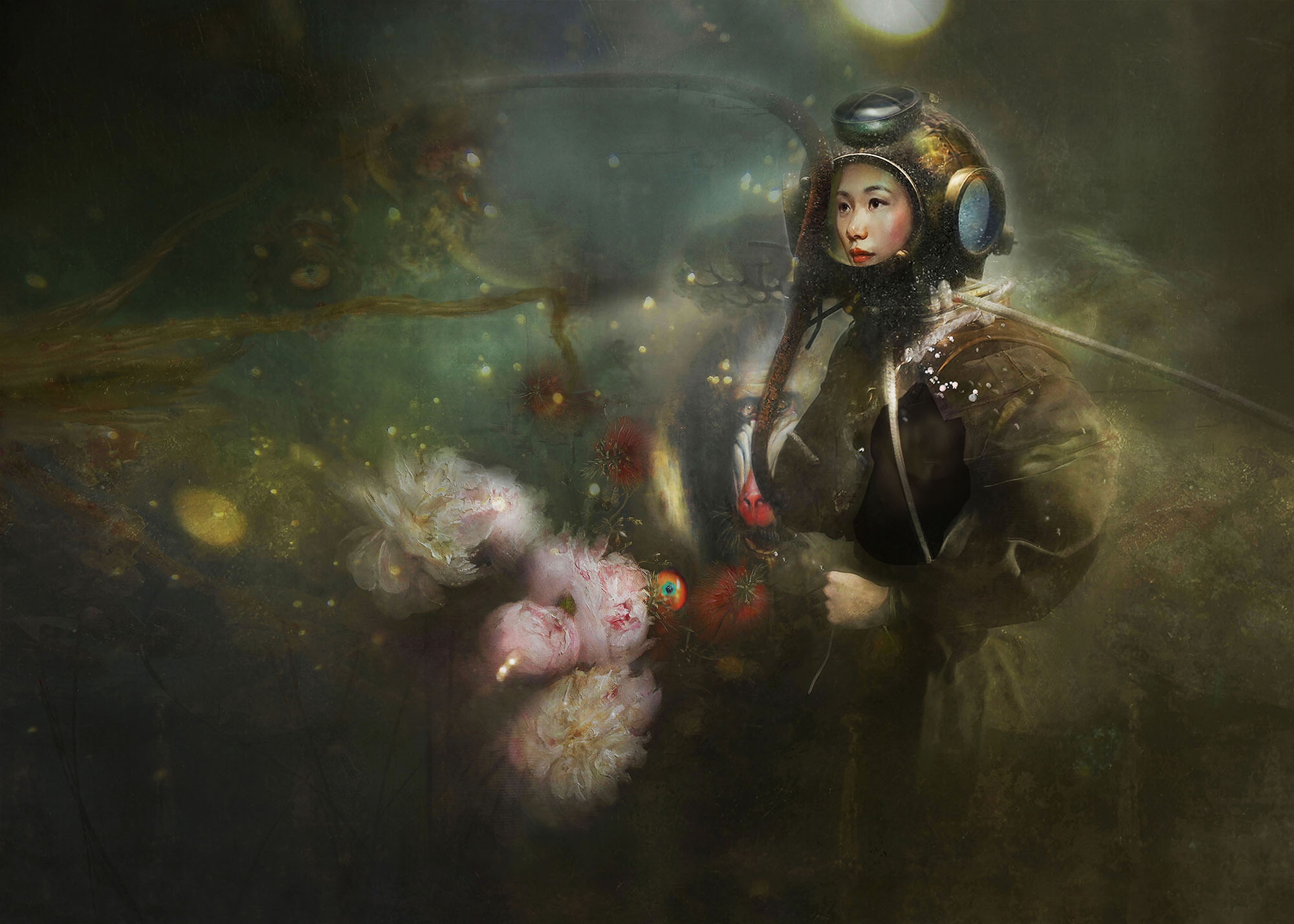
In “Diver,” Iva Troj captures the breathless suspension between two worlds, using the act of submersion as a powerful metaphor for emotional depth and introspection. Eschewing the traditional chaos of a fall, Troj’s figure moves with a serene, purposeful grace, suggesting a conscious descent into the subconscious or the “unseen” self. Through her signature use of ethereal light and fluid transparency, the painting transforms a moment of vulnerability into one of profound discovery—reminding us that to truly find one’s footing, one must first be brave enough to let go of the surface.
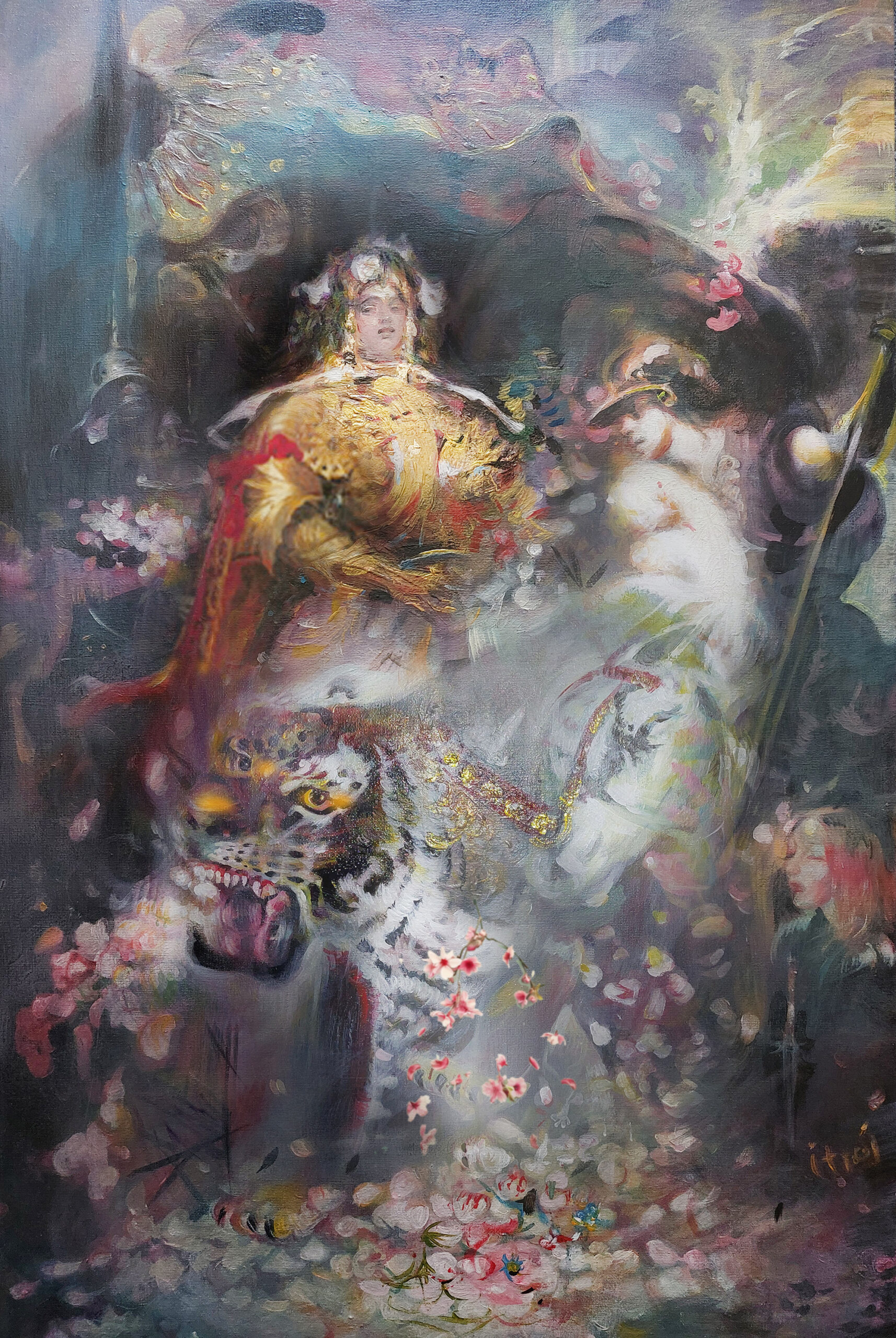
In “For The Flowers and Birds,” Iva Troj transforms the traditional Renaissance royal portrait into a soaring anthem of guardianship. Depicting her sister as a Queen Warrior, the work transcends mere likeness to capture the fierce, protective grace required to shield the delicate. By surrounding the regal figure with the titular flowers and birds, Troj identifies these as the true kingdoms worth defending—the fragile, the natural, and the free. Here, strength is not measured by conquest, but by the capacity to provide sanctuary. It is a profound tribute to a sister’s spirit, positioning her not as a ruler of people, but as a sovereign protector of life’s most ephemeral beauty.
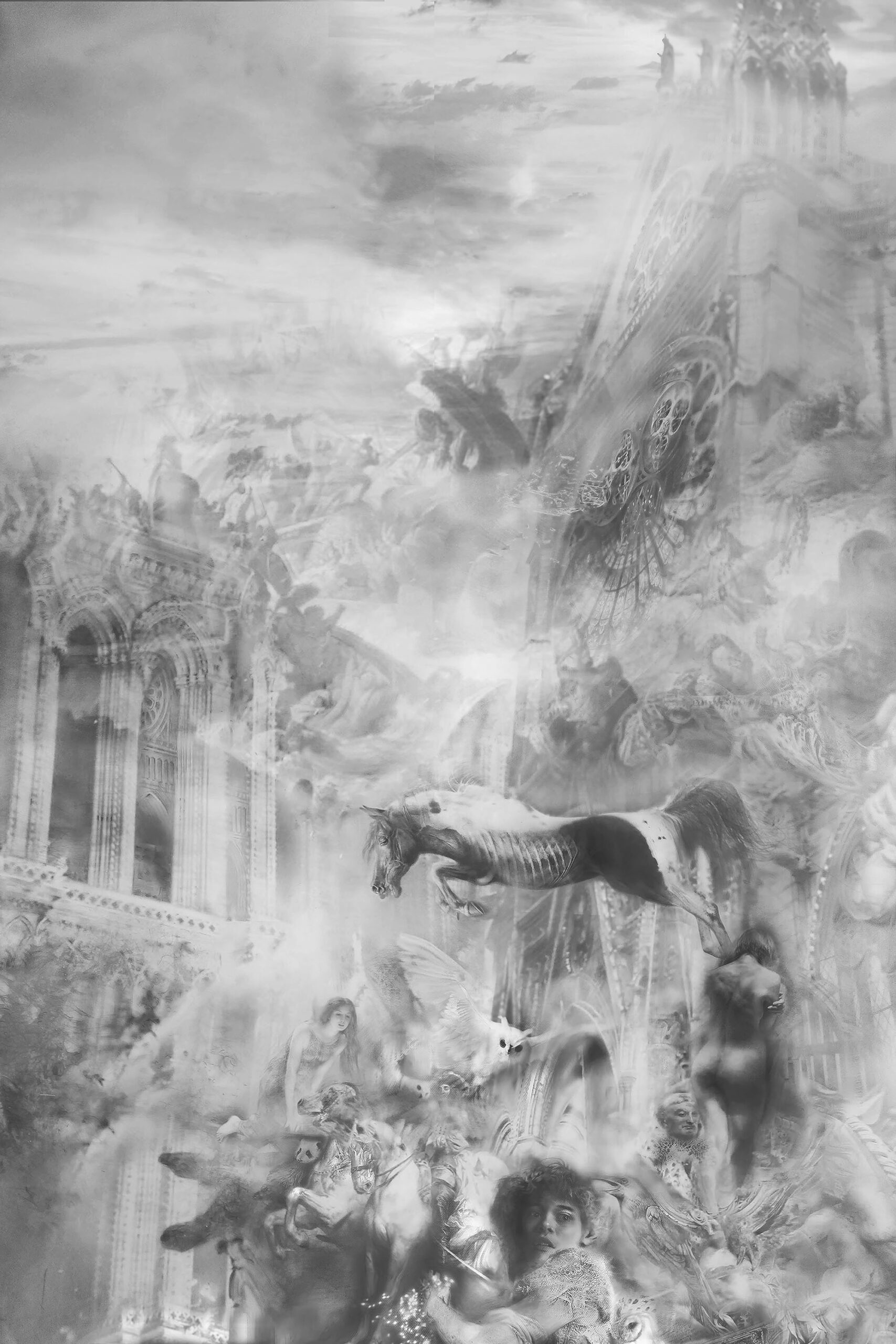
In “Mankind,” the foundational work of an original pencil drawing series, Iva Troj translates the grand theater of history into an intimate, internal battle for the soul. By casting her late brother in the shifting roles of warrior, prince, and knight, she elevates the personal journey of being true to oneself to the level of epic myth.
The choice of graphite allows for a raw, visceral precision, stripping away the artifice of color to focus on the structural integrity of character. This is not a depiction of external conquest, but a study of the quiet bravery required to maintain one’s humanity in a deconstructing world. Through these shifting archetypes, Troj honors her brother’s memory not as a static figure, but as a living symbol of the nobility found in the struggle for personal authenticity.
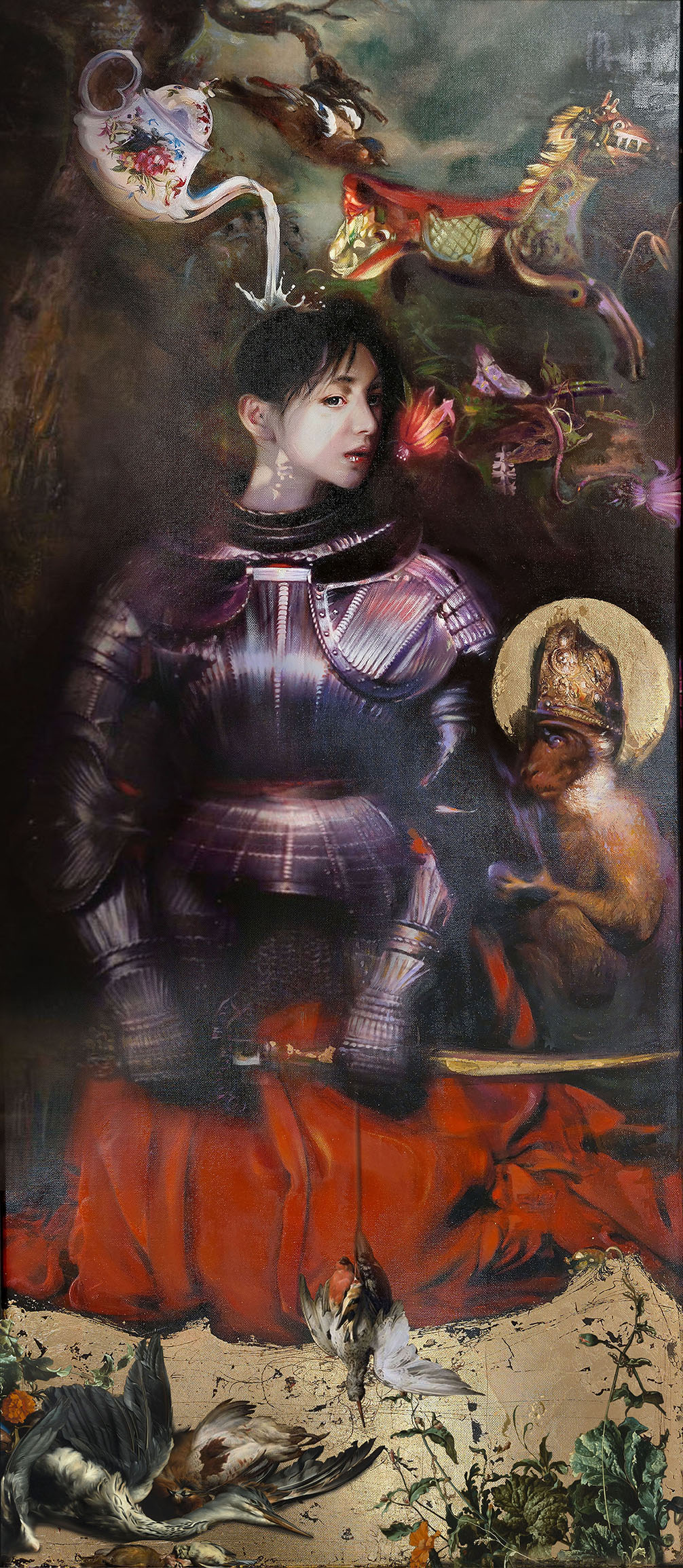
In “Night In Armour,” Iva Troj masterfully deconstructs the traditional symbol of the knight, transforming a suit of cold steel into a vessel for introspective and emotionally layered vulnerability. Rather than depicting a figure prepared for outward combat, this oil on canvas captures a moment of profound interiority—the quiet, heavy weight of the soul behind the protective shell.
The “armour” here serves as a dual metaphor: both a sanctuary for the delicate self and a burden of the roles we are forced to inhabit. Through Troj’s signature play of light and shadow, the rigid metal takes on an almost organic, luminous quality, suggesting that true strength is not found in the impenetrability of the surface, but in the complex, human depth it guards. It is a hauntingly beautiful meditation on the silent vigils we keep within ourselves, bridging the gap between the chivalric past and the psychological realities of the modern era.
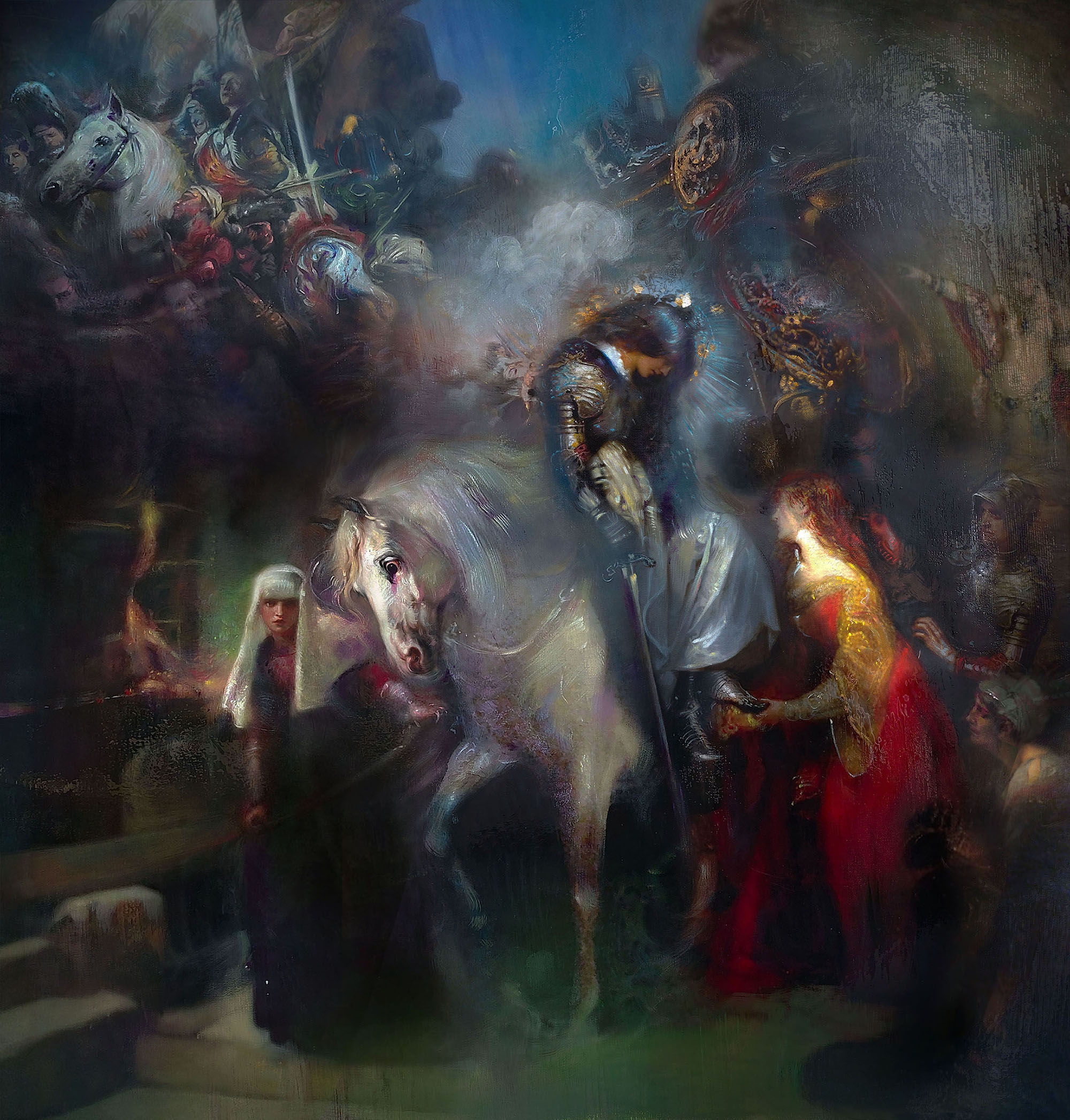
In “In The Knight, Godiva,” Iva Troj masterfully deconstructs the legendary Lady Godiva, shifting the narrative from one of passive exposure to one of active, strategic sacrifice. While the historical myth centers on a nude figure defined by her vulnerability, Troj’s Godiva is fully armored, reimagined as a warrior-saint who has already navigated the “ride” and is now prepared to dismount and face her destiny on her own terms.
The technical execution—characterized by luminous, Flemish-style glazes—gives the metal a celestial glow, suggesting that her protection is as much spiritual as it is physical.
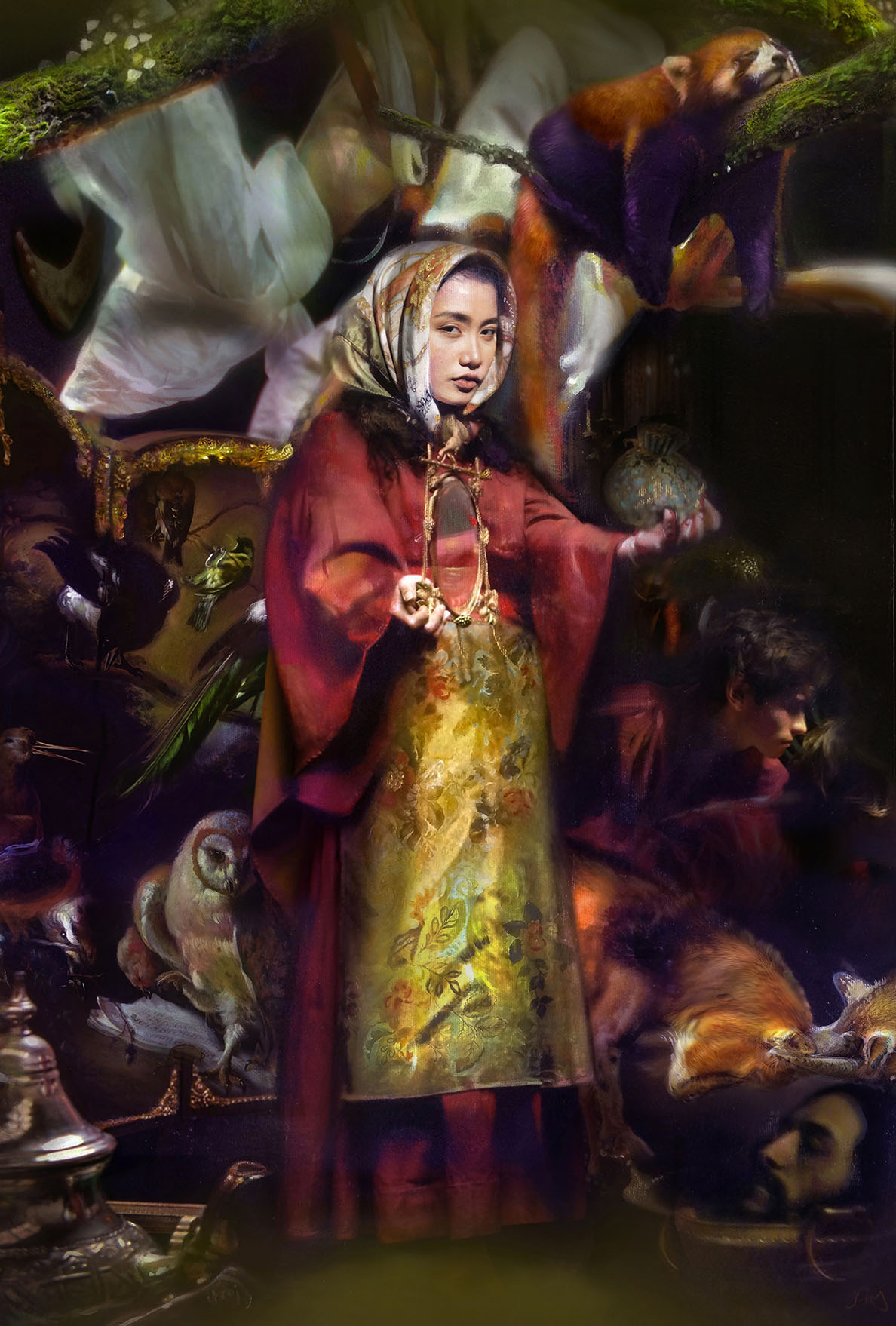
In “Leave That War With Me III,” Iva Troj delivers a cinematic and emotionally charged masterpiece, originally commissioned as the cover for the 41st edition of The Guide Artists magazine. The title itself serves as a poignant vow of shared burden, reflecting a narrative of profound empathy and the courageous act of carrying another’s trauma.
The work is a breathtaking showcase of Troj’s technical lineage, utilizing a meticulous Flemish-inspired method. This “optical mixing” allows light to penetrate the surface and reflect back through the pigment, imbuing the figures with a haunting, lifelike vitality. In this third iteration of the series, the “war” being left behind is not merely a physical conflict, but a psychological one, rendered with the grace and gravity of a contemporary Old Master.
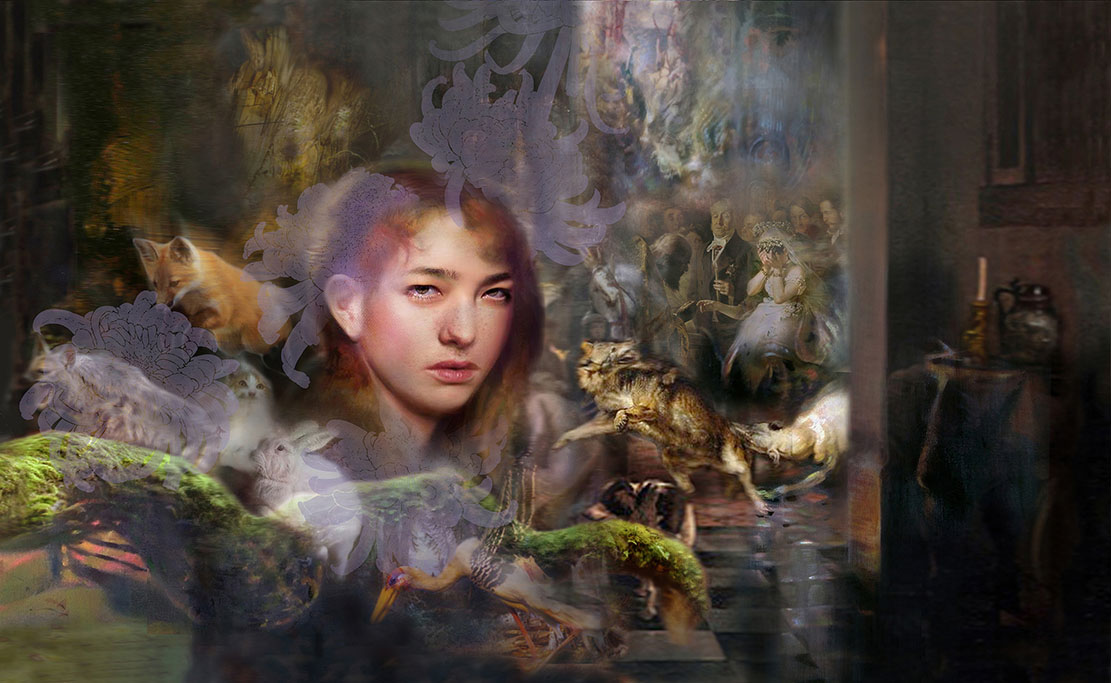
For the cover of her upcoming graphic novel, “Origami Wine,” Iva Troj delivers a hauntingly cinematic oil painting that centers on a striking portrait of a young Roma girl. The work reclaims a classic, historical motif—the child bride—but strips away the traditional tragedy to reveal a core of quiet resolve and burgeoning power.
In this composition, Troj explores the delicate, often volatile relationship between human intent and the natural world. The painting serves as a visual allegory for surrender versus resistance: a reminder that when we fight against the current of existence, nature resists us, but when we embrace its chaotic flow, it becomes a formidable ally.
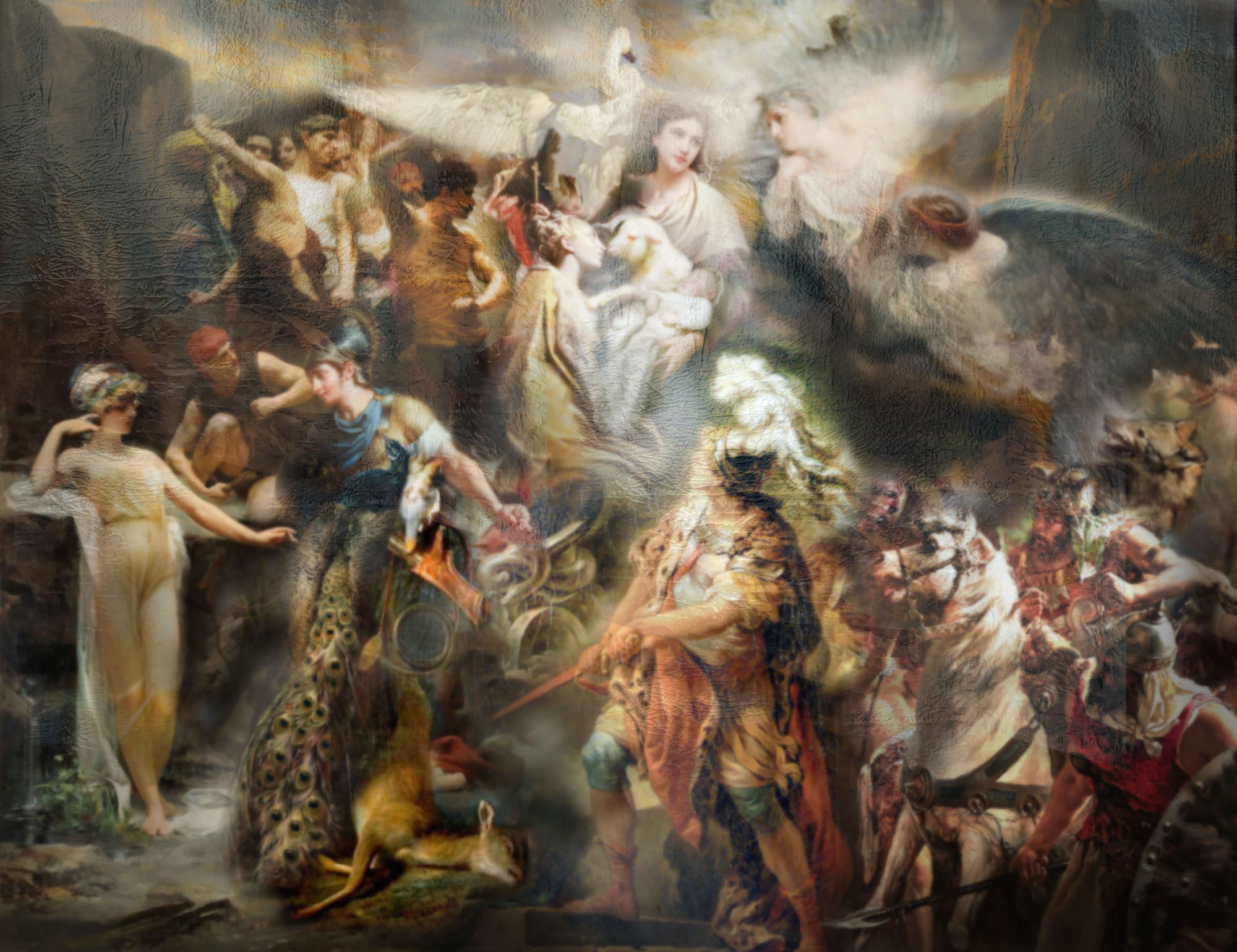
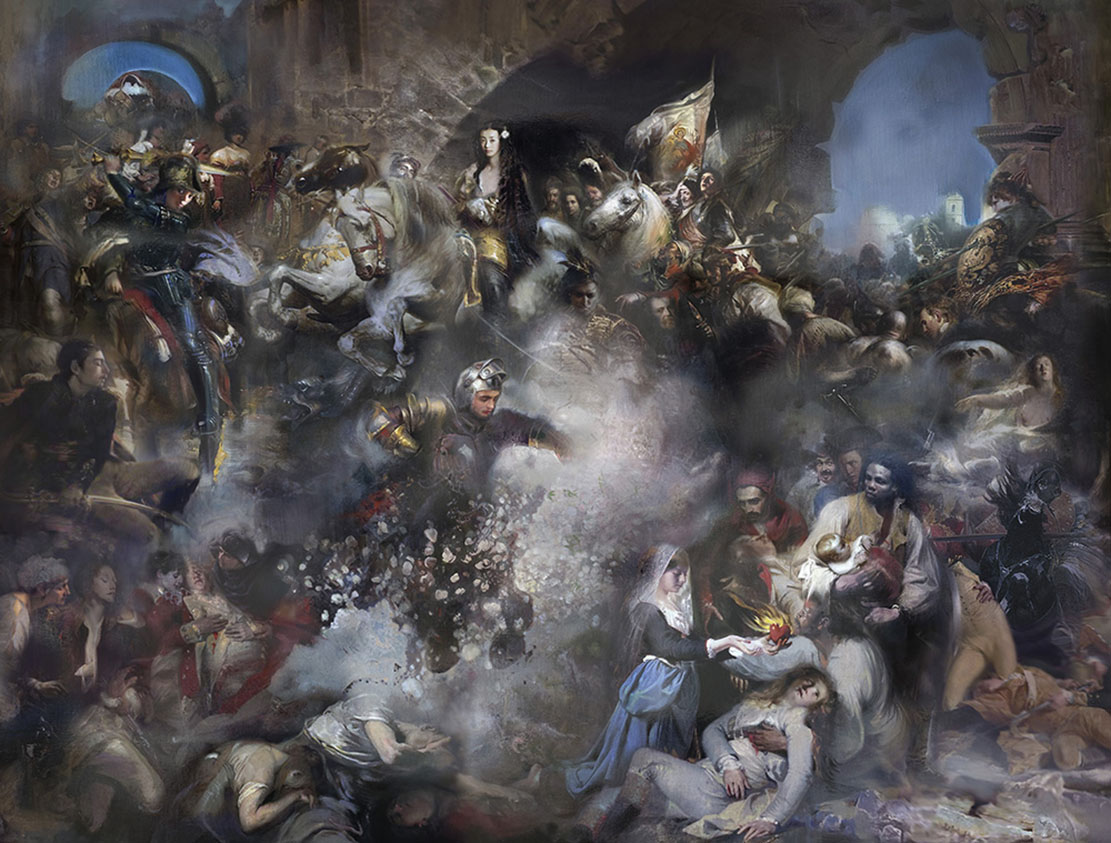
In this recent, large-format masterpiece, Iva Troj presents one of her most densely populated and ambitious compositions to date. This sprawling oil painting serves as a grand theater of metamorphosis, where Troj systematically deconstructs the rigid dichotomies of classical art history to reveal a more fluid, human truth.
Within this intricate web of figures and motifs, traditional power structures are inverted: dominance dissolves into vulnerability, and the energy of hate is transmutated into a profound, restorative love. By weaving together elements that challenge the “fake” in favor of the “true,” Troj navigates the visceral reality of pain as a catalyst for change. The painting’s scale and crowded narrative mirror the complexity of the contemporary psyche, suggesting that through the chaos of transformation, we find a more authentic version of ourselves.
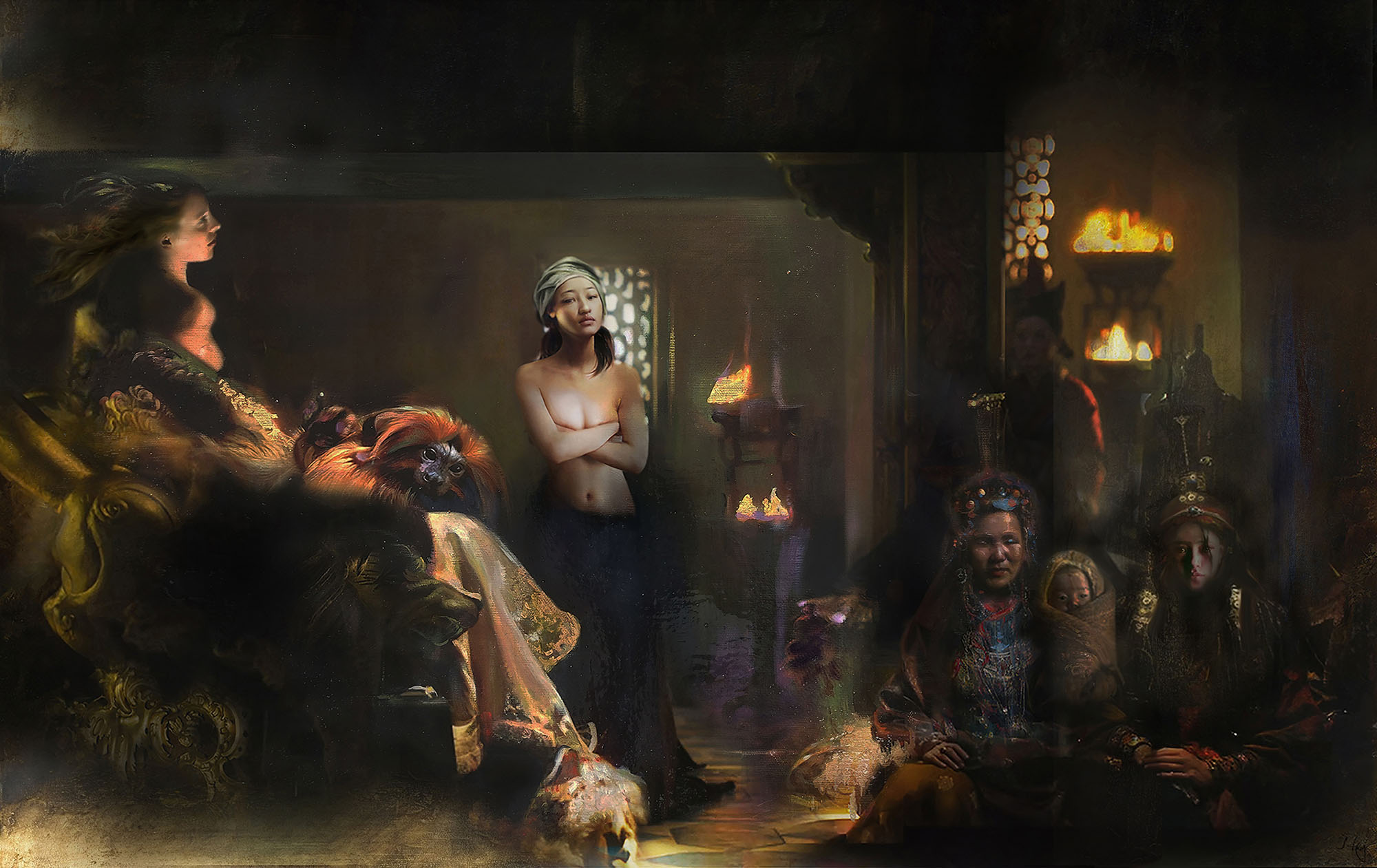
‘The Ceiling’ is, in Troj’s own words, ‘one angry painting.’ The sharp lines and the lack of breathable air in the composition create an almost claustrophobic intensity that is rare even in Troj’s emotionally charged body of work. The painting was born from ‘powerful images of darkness lit by fires burning in ancient candle stands’ — a vision that Troj attempted to populate with beings ‘without robbing them of their integrity.’ Her process was characteristically intuitive: she watched a documentary, began drawing, went to bed with drawings scattered around, and kept ‘whatever made sense in the morning.’ The result is a painting that operates on multiple levels simultaneously. Troj describes aiming at ‘a master vs slave dichotomy that is elusive — as in apparent only if you look at it directly but invisible if you add the surrounding figures.’ This elusiveness is key to understanding Troj’s approach to ideology: ‘messing with conventional truths is how you crack it all open and you can’t do that in a loud voice. If the ideology you seek to disrupt is hiding in the gutter then you need to get on your knees and dig.’
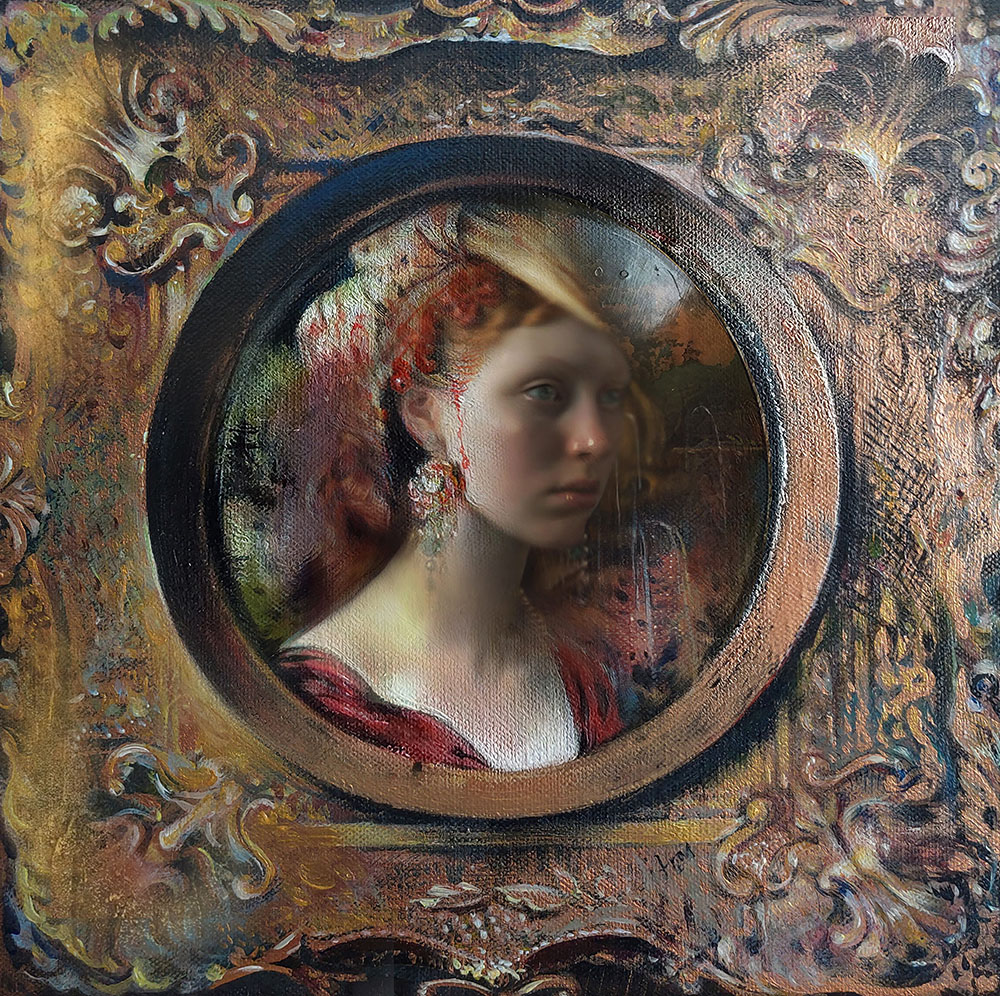
In “No Man,” Iva Troj presents a striking study in contrast, centered on a young woman illuminated by a sharp, directional light that carves her presence out of the shadows. Although she is enveloped by a world of opulence and gold, her attire remains humble—simple garments that serve as a visual testament to hard work, manual labor, and the quiet wisdom gained through lived experience.
The title itself suggests a reclamation of space; this is a sanctuary where the masculine gaze is absent, allowing for a moment of pure, uninterrupted contemplation. Troj uses the surrounding “luxury” not as a sign of wealth, but as a metaphor for the richness of the subject’s inner life. The side-lighting emphasizes the textures of her modest clothing against the shimmering background, creating a powerful dichotomy: while the world around her may be gilded, her true value is rooted in the earth, in effort, and in the profound dignity of a self-made spirit.